


The Buyer Intelligence Guide Every International Supplier Needs Before They Send a Single Email
81% of B2B buyers choose their preferred vendor before making any direct contact with a sales team. In Kenya’s relationship-driven market, by the time a buyer reaches out to you, they have already decided whether you are worth their time.
Most articles about B2B marketing in Kenya are written from the seller’s perspective: how to write cold emails, which trade shows to attend, how to find distributors, how to build pipeline. This article is different.
This article is written from the buyer’s perspective — specifically, from inside the mind of a Kenyan or East African B2B decision-maker who is evaluating whether to work with an international supplier.
Understanding how East African buyers actually research, evaluate, and ultimately choose international suppliers is the single most underutilised competitive advantage available to international companies entering Kenya. Because once you understand the journey your buyer is on — which channels they use, which signals they trust, which friction points kill deals, and which moments in the process determine outcomes — every element of your market entry strategy can be aligned to meet them where they actually are.
This is not theoretical. The data from 2026’s most authoritative B2B buyer behaviour research — combined with LeadWhizz’s direct experience managing outreach to East African decision-makers across 20+ industries — makes the Kenyan B2B buyer journey visible, mappable, and actionable.
The Data That Changes How You Think About Reaching Kenyan Buyers
Before mapping the journey, the global 2026 B2B buyer behaviour statistics that apply with equal or greater force in the East African context:
| 81% of B2B buyers choose their vendor before making any direct contact with a sales team 90% of B2B buyers use search tools including Google and AI to research vendors anonymously 54% of buyers speak to current users of a product before finalising a purchase decision 71% of buyers proceed with a supplier from their first shortlist — making shortlist entry the critical milestone 6–10 decision-makers are involved in a typical B2B purchase — not one person, a committee 55% of hidden decision-makers use thought leadership content as part of their supplier vetting process Source: SEO Works B2B Buyer Behaviour Statistics 2026; Corporate Visions B2B Buying Behavior 2026; Tomba.io Buyer Behaviour 2026 |
Each of these statistics carries a specific implication for international companies marketing to Kenyan buyers. We return to each one throughout this guide. But the headline implication is already clear: the Kenyan buyer’s journey is largely invisible to you until it is almost over. The companies that win in this market are the ones that show up during the invisible stages, not just when the buyer is ready to talk.
Why the Kenyan B2B Buyer Journey Is Different From What You Know
Global B2B buyer behaviour data gives international companies a useful framework. But applying that framework to Kenya without understanding the local dynamics that modify it produces misaligned strategies that consistently underperform. Here is where the Kenyan B2B buyer journey diverges most significantly from the global model:
| Factor | Global B2B Buyer Behaviour | Kenya-Specific B2B Buyer Behaviour |
| Trust basis | Contract-first — legal frameworks establish the foundation | Relationship-first — personal trust is established before the contract is signed |
| Research channels | Google, LinkedIn, industry publications, analyst reports | Google + WhatsApp peer networks + LinkedIn + personal referrals carry equal or greater weight |
| Decision speed | Faster in mature markets with established supplier categories | Slower — relationship validation adds time, but the resulting partnership is more durable |
| Stakeholder involvement | 6–10 decision-makers in complex purchases globally | Similar number — but with greater weight given to senior personal endorsement and cultural fit |
| Price sensitivity | Total cost of ownership drives decisions | Price matters but is secondary to reliability, after-sales support, and demonstrable trust |
| Post-sale expectations | Contractual SLAs define the relationship | Ongoing personal engagement — WhatsApp, phone calls, occasional visits — expected and valued |
| Reference validation | Case studies and reviews consulted | Personal peer references carry significantly more weight than published case studies |
| Digital vs in-person | Digital channels increasingly dominant in early stages | Digital researches the supplier — but personal interaction still closes the deal in most categories |
The most commercially significant difference is the role of personal trust in Kenya’s B2B buyer journey. In western B2B markets, legal and contractual frameworks reduce the personal trust threshold required before a transaction proceeds. In Kenya, as in most East African markets, personal trust is established before and alongside the contractual relationship, not as a consequence of it.
This means the buyer journey in Kenya has an additional layer that most international supplier outreach strategies never address: the personal credibility of the supplier’s representative, the quality and responsiveness of their communication, and the demonstrable signals of commitment to the local market are all evaluated as part of the decision , not separately from it.
In Kenya, you are not just selling a product. You are being evaluated as a potential long-term business partner. Every touchpoint in the buyer journey — the first email, the WhatsApp follow-up, the meeting preparation, the speed of your response — is part of that evaluation.
The 7-Stage B2B Buyer Journey in Kenya: A Complete Map
Based on global buyer behaviour research adapted for the East African context, and LeadWhizz’s direct experience across 20+ industry verticals in Kenya and Tanzania, here is the complete B2B buyer journey in Kenya, mapped stage by stage with what it means for international suppliers at each point:
| # | Stage | What Happens | What This Means for International Suppliers | What Wins Here |
| 1 | Problem Recognition | A pain point emerges — a supplier fails, costs rise, a new project demands new inputs. Often triggered by a colleague’s recommendation or an internal review. | This stage is almost entirely invisible to international suppliers. The buyer is not yet searching externally. | Be present in the channels buyers use before they start searching. LinkedIn thought leadership and Google-ranked content work here. |
| 2 | Anonymous Research | Buyer searches Google, asks WhatsApp contacts, checks LinkedIn. 90% of buyers use search tools to research vendors. 81% will form a preference before contacting any supplier. | Buyers are evaluating you before they have contacted you. Your website, LinkedIn, and content are doing the selling — or losing the deal. | Rank for the search terms East African buyers use. Professional LinkedIn presence. Articles that answer questions they are already asking. |
| 3 | Peer Validation | 54% of buyers speak to current users of a product before finalising. In Kenya specifically, WhatsApp networks and professional associations carry enormous weight. | A single negative word-of-mouth reference in a WhatsApp group of procurement managers can eliminate a supplier from consideration before first contact. | Client references from other East African companies. Testimonials in the buyer’s sector. Visible trust signals that work in Kenya’s network-driven professional culture. |
| 4 | Shortlist Formation | Buyer creates a shortlist of 2–4 suppliers. 71% go on to choose from their first shortlist. Getting on the shortlist is more important than winning the pitch. | If your brand is not known before the shortlist is formed, you are competing for a spot that is already effectively taken. | Verified outreach that reaches buyers during Stage 2 and 3 — before shortlists are built. LeadWhizz’s pre-qualification process positions your brand at this stage. |
| 5 | Formal Evaluation | Multi-stakeholder review. In Kenya, an average of 6–10 decision-makers are involved in significant B2B purchases. Quality, compliance, pricing, track record, and local references all assessed. | Generic proposals fail here. Buyers in Kenya evaluate technical fit, KEBS compliance, after-sales support, and cultural alignment alongside price. | Meeting-specific proposals. KEBS compliance documentation ready. East African case studies. Local agent or representative who can answer questions in real time. |
| 6 | Final Decision & Approval | 79% of B2B purchases require CFO or senior finance approval. In Kenya’s corporate and government context, this stage often involves multiple sign-offs and can extend the timeline significantly. | Deals that appear to be agreed can stall for weeks at approval stage. Buyers need internal justification materials — not just a supplier pitch. | Provide buyers with the materials they need to justify the decision internally: ROI calculations, compliance documentation, reference letters, warranty terms. |
| 7 | Supplier Onboarding | The buyer transitions from evaluating to implementing. How smoothly this stage goes determines whether the relationship becomes long-term. | International suppliers who disappear after the first order — without training, support, or onboarding — quickly lose account to local competitors. | Structured onboarding, local support through a trusted partner, clear communication channels. This is where long-term East African partnerships are cemented. |
💡 The most important insight from this map: international suppliers who wait until Stage 5 (Formal Evaluation) to make their first contact are competing for a shortlist slot that has often already been allocated. Effective market entry in Kenya requires being present in Stages 2 and 3 — the anonymous research and peer validation stages — when buyers are forming preferences without telling anyone.
The WhatsApp Factor: Kenya’s Invisible B2B Research Channel
One element of the Kenyan buyer journey that no global B2B research adequately captures is the role of WhatsApp in professional B2B decision-making.
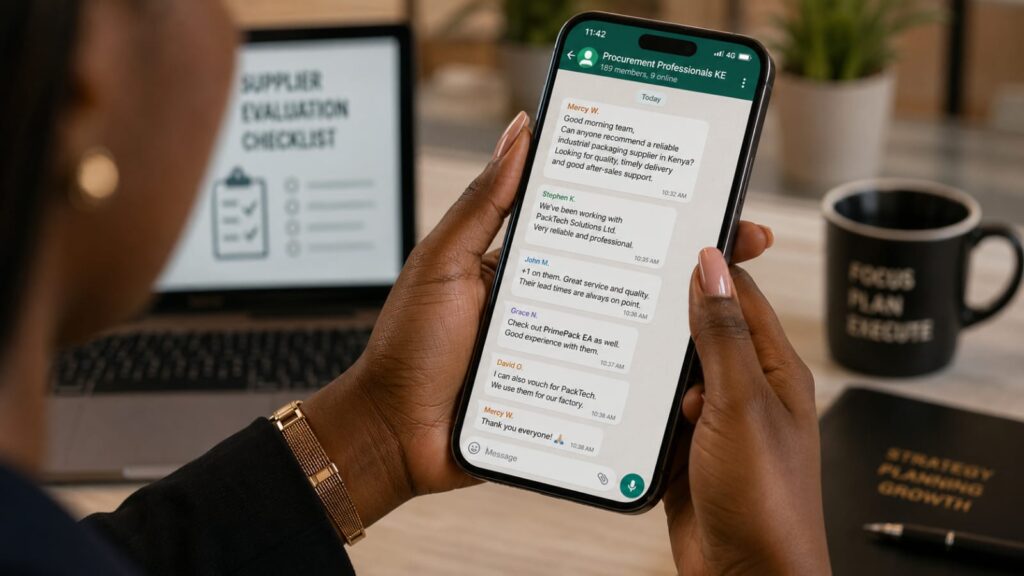
In Kenya, WhatsApp is not just a personal communication tool. It is the primary channel through which procurement managers, MDs, and business owners share supplier recommendations, warn colleagues about poor performers, and validate potential new suppliers with trusted peers. A question posted in a WhatsApp group of ten procurement managers — ‘has anyone worked with X company?’ — can produce five responses within an hour that are more influential than any amount of formal marketing material.
This has three direct implications for international suppliers:
- Reputation spreads faster and wider than you know: a single positive or negative experience with a supplier in Kenya can reach dozens of relevant decision-makers within days, through WhatsApp networks that are invisible to the supplier
- Your brand presence needs to exist before buyers start asking about you: when a Kenyan procurement manager asks their WhatsApp network about a supplier, the ideal outcome is that multiple contacts already have positive things to say — which only happens if the brand has been building local credibility over time
- WhatsApp outreach in the right tone is a powerful commercial channel: 90% of Kenyan professionals use WhatsApp daily — and a brief, professional, well-timed WhatsApp follow-up from a local number can re-open conversations that email alone cannot
The 6 Trust Signals That Kenyan B2B Buyers Actually Look For
Across the seven stages of the Kenyan buyer journey, six trust signals consistently determine whether an international supplier advances from consideration to shortlist to preferred partner. Most international suppliers are strong on one or two of these and absent on the rest — which is why their conversion rates in Kenya are lower than their product quality justifies.
| Trust Signal | What It Communicates to the Kenyan Buyer | Why It Works |
| Local phone number and WhatsApp presence | Signals: you understand how business is done here. Absence signals: you are a distant foreign supplier with no real local commitment. | Dramatically increases response rates at every stage of outreach |
| East African client references | A reference from a company in Nairobi or Dar es Salaam means infinitely more to a Kenyan buyer than a reference from Munich or Seoul. | Validates real-world performance in the same business environment |
| KEBS and regulatory compliance documentation | Buyers evaluating your product for the Kenyan market need to know you have done the compliance homework — not that they will need to do it for you. | Removes a major late-stage deal blocker that kills many international supplier conversations |
| Professional website with Kenya/East Africa content | A generic global website signals you are testing the market. A website that speaks to East African buyers signals genuine commitment. | Establishes relevance during the anonymous research stage — before any contact is made |
| Thought leadership content on East African B2B topics | 55% of hidden B2B decision-makers use thought leadership as part of their vetting process — and LeadWhizz’s own articles reaching Kenyan buyers confirm this pattern. | Positions your brand as expert and locally informed before first contact |
| Fast, professional follow-up from local numbers | A prompt, personalised follow-up from a local Kenyan number is among the strongest trust signals available at the early relationship stage. | Converts warm interest into confirmed meetings faster than any other single tactical element |
The 5 Most Common Mistakes International Suppliers Make in the Kenyan Buyer Journey
Understanding the buyer journey also means understanding where international suppliers most consistently lose deals that should have been won:
1. Entering Too Late — After the Shortlist Is Already Built
The most common and most costly mistake. International suppliers focus their outreach on buyers who are already in Stages 5 and 6 — actively evaluating and selecting — without realising that by this point, 71% of buyers have already mentally committed to a supplier from their initial shortlist. The buyers who converted were warmed months earlier, during Stages 2 and 3. LeadWhizz’s pre-event and ongoing outreach programmes are specifically designed to reach buyers at Stages 2 and 3 — when preference is forming rather than when it has already formed.
2. Treating the Buyer as a Single Decision-Maker
A typical B2B purchase in Kenya involves 6–10 stakeholders across functions. International suppliers who build their entire relationship with one contact — the procurement manager they met at a trade show, for example — frequently lose deals when that contact’s recommendation cannot survive the multi-stakeholder evaluation process. Effective Kenya market entry requires mapping the full decision-making committee and ensuring that multiple stakeholders within the buyer organisation have positive impressions of the supplier brand.
3. Generic Follow-Up That Signals You Did Not Listen
A bulk email sent to everyone met at a Nairobi exhibition, with no reference to what was discussed, no personalisation to the buyer’s sector or project, and no clear next step — is the most reliable way to signal to a Kenyan decision-maker that you are treating them as a contact, not a potential partner. In a relationship-first market, this is not just ineffective. It actively damages the impression made in person.
4. Disappearing Between Touchpoints
In Kenya’s B2B market, consistency of presence is itself a trust signal. A supplier who responds promptly to the first inquiry and then goes silent for two weeks — because they are managing deals across multiple markets — is communicating exactly the opposite of what a Kenyan buyer needs to hear: that this supplier will be available and responsive when operational problems arise post-contract. Regular, professional touchpoints between meetings maintain buyer engagement and signal the long-term reliability that East African buyers weight heavily.
5. Competing on Price When the Buyer is Evaluating on Trust
Price matters in Kenya’s B2B market — but it is rarely the primary decision driver in the categories where international suppliers compete. Kenyan buyers evaluating an international supplier over a cheaper, less reliable local alternative are making a risk-weighted decision: is the premium worth the quality, warranty, and reliability guarantee? Suppliers who lead their proposals with price concessions signal that they do not understand what they are being evaluated on — and inadvertently raise doubts about quality rather than addressing them.
How LeadWhizz Aligns Your Outreach With the Kenyan Buyer Journey
LeadWhizz’s outreach system is built specifically around the Kenyan B2B buyer journey — reaching decision-makers at the stages where preference is formed, not just when they are ready to talk.
- Verified database targeting: we identify the right decision-makers by role, seniority, and sector — so your outreach reaches the actual buyer, not a junior gatekeeper
- Stage 2 and 3 presence building: through content distribution, LinkedIn engagement, and professional email outreach, we position your brand during the anonymous research and peer validation stages — before shortlists are built
- WhatsApp and phone follow-up from local numbers: local communication signals local commitment — the trust signal that most international suppliers miss entirely
- Meeting-specific preparation: every introduction we facilitate comes with a buyer brief — what the organisation does, their current procurement priorities, and why your offer is specifically relevant to them
- Post-meeting follow-up management: we deploy structured, personalised follow-up within 48 hours of every meeting — maintaining the momentum that the buyer journey requires to progress from evaluation to decision
| 🎯 Reach Kenyan B2B Buyers Before They Build Their Shortlist Here is exactly what happens when you contact LeadWhizz: 📞 Step 1: Contact LeadWhizz — by email or via our website 📅 Step 2: We respond within 48 hours to schedule your Free Discovery Call 🔍 Step 3: On the call, we map your ideal buyer profile in Kenya — their role, sector, company size, and where they are most likely to be in the buyer journey right now 📊 Step 4: Within 48 hours you receive your Free Campaign Audit — a buyer journey-aligned outreach strategy that reaches Kenyan decision-makers at the right stage, through the right channels 🚀 Step 5: We build your verified buyer database, launch your outreach, and position your brand in the research and peer validation stages — before your competitors do The Discovery Call is FREE. The Campaign Audit is FREE. By the time a Kenyan buyer contacts you, 81% have already formed a preference. LeadWhizz makes sure that preference is your brand. Verified Leads. Measurable Growth. Guaranteed Results. 📩 b2b@leadwhizz.africa | www.leadwhizz.africa |
Frequently Asked Questions
Q: At what point in the buyer journey do most Kenyan B2B decision-makers first contact a supplier?
Based on global B2B buyer behaviour research adapted for the Kenyan context, most decision-makers make first contact with a supplier only after they have already completed significant anonymous research — often after forming a preliminary preference. The 81% figure from 2026 buyer research (buyers who have already chosen a preferred vendor before making first contact) applies strongly in Kenya, where WhatsApp peer networks enable rapid anonymous validation that accelerates the pre-contact research phase. International suppliers who rely on inbound inquiries or trade show conversations to initiate relationships are consistently entering the buyer journey after the critical preference-forming stages have already concluded.
Q: How important is WhatsApp in the B2B buyer journey in Kenya compared to email?
WhatsApp is not a supplementary channel in Kenya’s B2B buyer journey — it is a primary one. For the peer validation stage of the journey, WhatsApp professional networks are the most influential channel a Kenyan buyer uses, operating invisibly to most international suppliers. For the follow-up and ongoing relationship stages, WhatsApp is the channel that maintains between-meeting engagement in the way that email alone cannot. LeadWhizz integrates WhatsApp into every outreach sequence we manage — from local Kenyan numbers, in culturally calibrated tone — because email-only outreach misses the channel where a significant proportion of B2B preference is formed and maintained.
Q: How many decision-makers are typically involved in a B2B purchase in Kenya?
In significant B2B purchases in Kenya — distribution agreements, technology contracts, supply arrangements above a meaningful financial threshold — the number of stakeholders involved in the decision typically ranges from 4 to 10, consistent with global B2B buying committee research. The composition varies by sector: in corporate private sector purchases, the committee typically includes the procurement manager, the relevant business unit head, a finance approver, and increasingly a technical or IT stakeholder. In government procurement, the accounting officer, procurement officer, and technical evaluator are required participants, with additional approval layers for higher-value contracts. Understanding this committee structure — and building relationships across multiple stakeholders rather than a single contact — is essential to successfully navigating the Kenyan buyer journey.
Q: How long does the B2B buyer journey typically take in Kenya from initial awareness to signed agreement?
The timeline varies significantly by sector, purchase size, and buyer type. For distribution agreements in FMCG or industrial sectors with a private sector buyer, the typical journey from first meaningful contact to signed agreement is 8 to 16 weeks — longer than equivalent arrangements in western markets, reflecting the relationship validation stages that Kenya’s business culture requires. For technology and SaaS contracts with sophisticated corporate buyers in Nairobi, the timeline can compress to 6 to 10 weeks where the supplier has already built brand familiarity. Government procurement timelines are longer — typically 3 to 6 months from initial engagement to contract award, depending on procurement route and contract value. LeadWhizz helps international suppliers enter buyer journeys at earlier stages, which compresses the time from first contact to agreement without shortcutting the relationship-building that East African buyers require.
Q: What is the single most effective thing an international supplier can do to improve their conversion rate with Kenyan buyers?
The single highest-leverage change is reaching buyers during the anonymous research and peer validation stages — Stages 2 and 3 of the buyer journey — rather than waiting for inbound inquiries or trade show meetings. This means having a professional website with content that ranks for the search terms East African buyers use, a consistent LinkedIn presence that positions your brand as a credible expert in your category, East African client references that validate your product in the local context, and outreach through verified databases that reaches the right decision-makers before they have already built their shortlist. LeadWhizz’s pre-event and ongoing outreach programmes are specifically designed to create this early-journey presence for international suppliers — which is why the clients who work with us consistently report higher conversion rates from East Africa than from their self-managed outreach efforts.
Leave a Reply