
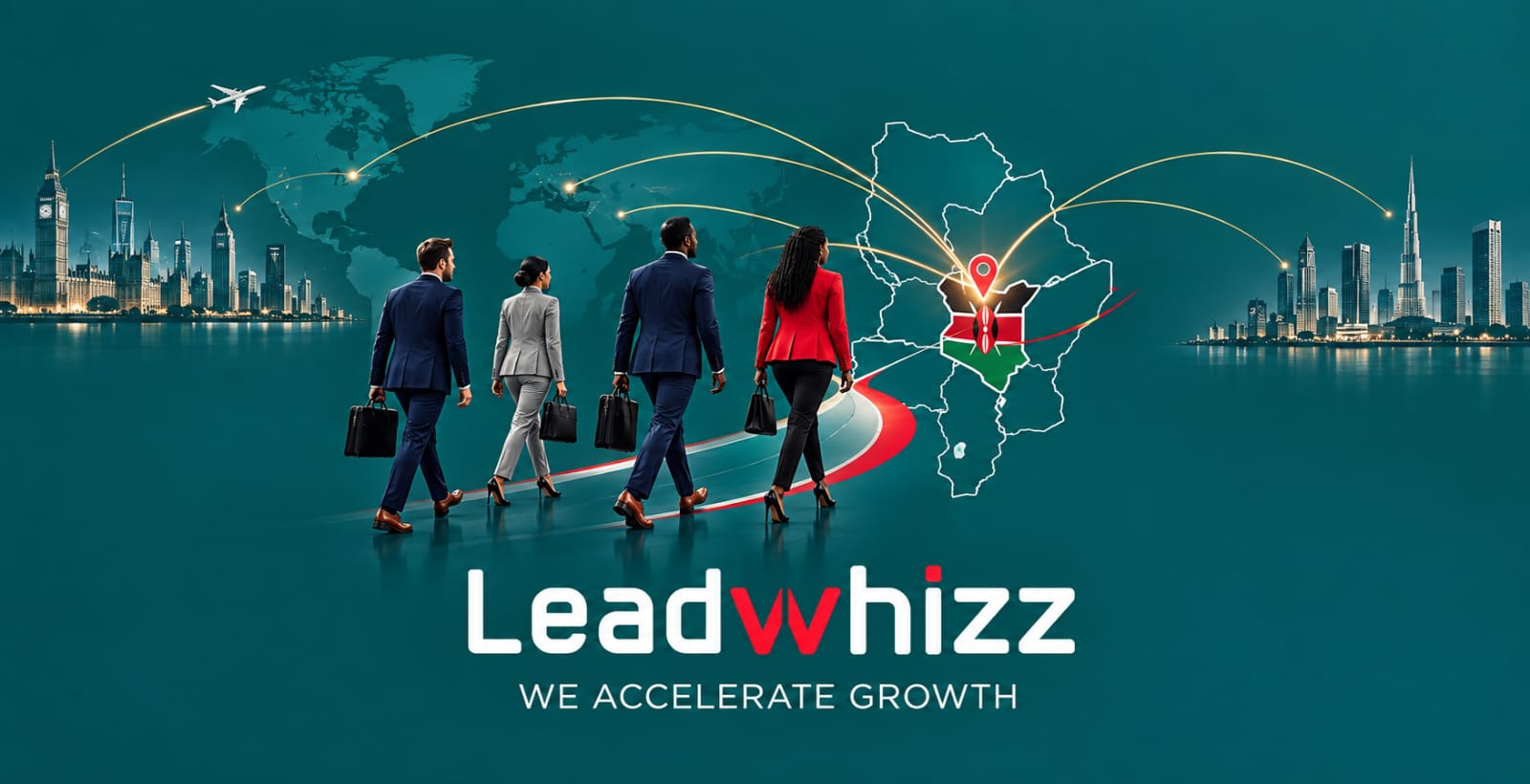

The Complete Guide to Entering Kenya, Tanzania, and East Africa — With Verified Partners, Qualified Pipeline, and Real Commercial Outcomes
Kenya is not an emerging opportunity. It is a current one. And East Africa’s 360 million-person market is not waiting for international companies to discover it. The question is not whether to enter — it is whether you enter with the right intelligence, the right partners, and the right support.
International companies approach market entry in Kenya and East Africa from every direction. Some arrive with a clear product and a targeted distributor brief. Some come for a trade mission and want to know how to convert the conversations into pipeline. Some are exporting manufacturers looking for their first verified importer. Some are technology companies searching for their first East African reseller. Some are professional services firms seeking the right joint venture partner before committing to a local presence.
What they share — regardless of sector, size, or entry strategy — is a common set of challenges: finding the right local partner without months of wasted outreach, building credibility in a relationship-first market without a local office, navigating regulatory and compliance requirements that vary by sector and entry mode, and generating qualified pipeline before committing to full market entry investment.
LeadWhizz exists to resolve every one of those challenges — with verified intelligence, locally-calibrated outreach, B2B and B2G matchmaking, trade mission support, and ongoing commercial presence in Kenya and East Africa that acts as an operational extension of your business in the region.
This guide covers the full market entry picture — why Kenya and East Africa, which entry mode fits your strategy, the six challenges that most commonly stall international companies in this market, and the complete LeadWhizz service suite that supports every stage of the journey from first research to ongoing pipeline.
Why Kenya and East Africa: The Market Entry Case in 2026
The commercial case for Kenya and East Africa market entry in 2026 is not built on potential. It is built on performance — confirmed by the year’s most authoritative economic data, investment flows, and bilateral trade figures.
| $120B Kenya’s GDP in 2024 — East Africa’s largest economy, with services at 60% of output and 4.7% projected growth in 2026 |
| 360M+ Population of the East African Community’s eight partner states — the combined market accessible through a Kenya-anchored partnership |
| $4.31B India–Kenya bilateral trade in FY2025–26 — up 25% year on year, confirming Kenya’s rising status as a destination for international B2B partnership |
| $2.9B Diversified investment deals confirmed at KIICO 2026 — Kenya International Investment Conference — signalling the depth of inbound commercial interest |
Kenya is actively positioning itself as the entry point to East Africa and the broader African continental market. Kenya’s High Commissioner to India described the country in June 2026 as ‘a strategic gateway to the broader African market’ — a message being delivered simultaneously to business communities across Europe, Asia, and the Americas. The Kenya Investment Authority offers specific facilitation and aftercare support to foreign investors, including manufacturing, pharmaceutical production, food processing, renewable energy, digital infrastructure, logistics, and agricultural technology.
For international companies, this means Kenya is not just a single market opportunity. It is a regional platform — and through the AfCFTA’s progressively reducing trade barriers, a Kenya market entry in 2026 increasingly provides commercial access to the entire East African Community and beyond.
📌 Kenya offers 10-year tax holidays for investments in Special Economic Zones and investment deduction allowances of up to 150% for manufacturing investments — making it one of the most incentivised manufacturing and export bases in sub-Saharan Africa for international companies establishing a regional production presence.
Choosing Your Kenya Market Entry Mode: 7 Options Compared
The right market entry mode depends on your sector, your capital appetite, your regulatory requirements, and your timeline. Here are the seven primary entry modes available to international companies entering Kenya — with an honest assessment of what each requires and delivers:
| Entry Mode | Capital Required | Speed to Market | What It Means in Practice |
| Direct Export | Low | Fastest | Supply your product directly to Kenyan buyers or distributors from your home country. No local establishment required. Ideal for validating demand before deeper commitment. |
| Distribution Partnership | Low–Medium | Fast | Appoint a verified Kenyan distributor to represent your product. They manage storage, sales, and last-mile delivery. Fastest route to shelf and market coverage. |
| Sales Agent / Representative | Low | Fast | A local agent earns commission on sales made on your behalf. No stock ownership. Low risk, lower control. Strong for sectors where personal relationships drive purchasing. |
| Joint Venture | Medium | Medium | Commercial partnership with a Kenyan company sharing equity, risk, and reward. Provides instant local credibility, government relationships, and market knowledge. |
| Local Entity / Subsidiary | High | Slower | Registered Kenyan company — private limited or branch office. Required for certain regulated sectors and for bidding directly on government procurement contracts. |
| Special Economic Zone | Medium | Medium | Establish operations inside Kenya’s SEZ framework — 10-year tax holidays, investment deductions up to 150%, and streamlined regulatory environment for manufacturing and export. |
| Franchise / Licensing | Low–Medium | Medium | License your brand, system, or technology to a local Kenyan operator. Scalable with low capital. Strong for service businesses, technology platforms, and retail concepts. |
For most international companies entering Kenya for the first time, the distribution partnership or sales agent model is the recommended starting point — providing market access with low capital commitment while the commercial relationship matures. LeadWhizz’s partner search service identifies and verifies the right distributor or agent for your specific sector and entry brief, removing the most common first-entry failure: choosing the wrong local partner.
The most expensive market entry mistake in Kenya is not choosing the wrong entry mode — it is choosing the right mode with the wrong partner. Partner verification is not due diligence for its own sake. It is the commercial decision that determines everything that follows.
The Six Challenges That Most Commonly Stall Kenya Market Entry — And How LeadWhizz Resolves Each One
International companies that have attempted Kenya market entry without a specialist local partner consistently report the same failure patterns. Here are the six challenges that most often stall or derail East Africa expansion — and exactly how LeadWhizz is built to resolve each one:
| Challenge | Why It Stalls Most Companies | How LeadWhizz Resolves It |
| Finding the right local partner | Most international companies either cannot identify suitable partners remotely or choose incorrectly — mismatched capacity, competing portfolio, or unreliable track record. | LeadWhizz builds a verified shortlist — every partner pre-screened for sector fit, capacity, compliance, and genuine commercial interest before introductions are made. |
| Building trust without a local presence | Kenyan buyers and government procurement officers require relationship signals that most remote outreach cannot provide — local numbers, local references, local understanding. | LeadWhizz acts as your local operational presence — outreach from Kenyan numbers, local agent follow-up, and market intelligence that signals genuine market commitment. |
| Regulatory and compliance navigation | KEBS product certification, import licensing, company registration, sector-specific regulatory approval — each market entry mode has different compliance requirements that are time-consuming to navigate remotely. | Pre-entry compliance mapping for your sector and market entry mode — so you know what is required before committing budget, not after. |
| Validating demand before committing | International companies frequently commit to a market entry structure before validating whether real demand exists at the price point and volume they require. | LeadWhizz’s verified outreach campaigns produce market intelligence alongside pipeline — response rates, objections, and buyer feedback that validate the commercial case before major investment. |
| Government procurement access | Kenya’s $6B+ annual public procurement market requires specific registration, AGPO compliance, and sector-appropriate procurement routes — none of which most international companies understand on first entry. | B2G meeting facilitation and procurement route mapping — identifying the right ministry, agency, or county government target and the correct procurement mechanism for your offer. |
| Multi-market complexity | Companies that want to enter Kenya and Tanzania simultaneously frequently underestimate the cultural, commercial, and regulatory differences between the two markets. | Country-specific strategies run simultaneously — Kenya and Tanzania treated as distinct markets with distinct outreach approaches, partner profiles, and relationship timelines. |
The Complete LeadWhizz Market Entry Service Suite
LeadWhizz provides end-to-end market entry support for international companies entering Kenya, Tanzania, and the wider East African region — from first market intelligence through to ongoing pipeline management and commercial presence. Here is the complete service architecture:
| # | Service | What It Solves | How LeadWhizz Delivers It |
| 1 | Market Intelligence & Demand Validation | Verify that real demand exists at your price point and volume before committing to a full market entry programme. | Verified outreach campaigns that produce buyer response data alongside pipeline — so market entry decisions are based on evidence, not assumption. |
| 2 | Partner and Distributor Search | Find the right distributor, importer, wholesaler, agent, or strategic partner — verified, sector-matched, and pre-qualified. | 3M+ verified East Africa contact database. Every shortlisted partner screened for capacity, portfolio fit, compliance status, and genuine commercial interest before introduction. |
| 3 | B2B Lead Generation and Pipeline Building | Build a qualified pipeline of buyers, procurement managers, and commercial decision-makers in Kenya and Tanzania. | Verified outreach — email, WhatsApp, and phone from local numbers — producing qualified meetings with decision-makers at the right seniority level. |
| 4 | Trade Mission and Delegation Meeting Support | Maximise the commercial return on an incoming Kenya visit — for a single company or a full trade delegation. | Pre-arranged, confirmed B2B and B2G meeting programmes built before departure. On-ground coordination during the visit. Post-mission follow-up deployed within 48 hours. |
| 5 | B2G Meeting Facilitation | Access Kenya’s $6B+ annual government procurement market — ministries, parastatals, and county governments. | Sector-appropriate government meeting targets identified, verified, and approached. Commercial B2G meeting facilitation with the right procurement-level contacts. |
| 6 | Post-Event and Post-Mission Follow-Up | Convert trade show and mission contacts into qualified pipeline before they go cold. | Personalised follow-up campaigns deployed within 48 hours — email, WhatsApp, and phone sequences segmented by interest level and next step agreed. |
| 7 | Ongoing East Africa Market Presence | Maintain active commercial engagement in Kenya and Tanzania without a local office or full-time local hire. | LeadWhizz as your operational extension — continuous verified outreach, pipeline management, and market intelligence as an ongoing managed service. |
Each service can be engaged independently or as part of a structured market entry programme. For companies beginning their East Africa journey, LeadWhizz recommends starting with a market intelligence and partner search engagement — validating demand and identifying the right distribution or partnership structure before investing in trade missions or full market entry infrastructure.
Country-by-Country Entry Readiness: Kenya, Tanzania, Rwanda, Uganda, and Ethiopia
East Africa is five distinct markets, not one. The entry readiness, sector opportunity, and recommended approach differs meaningfully across the region. Here is LeadWhizz’s 2026 country-by-country assessment:
| Country | Growth | Strongest B2B Sectors | Market Entry Signal | Recommended Approach |
| 🇰🇪 Kenya | 4.7% (2026) | Fintech, agritech, logistics, healthcare, construction, FMCG, professional services | Most accessible private sector. Deepest buyer ecosystem. AfCFTA gateway for EAC. | Start here for most sectors |
| 🇹🇿 Tanzania | 6.1% (2026) | Mining, agriculture, port logistics, construction, manufacturing | Slower relationship timeline. Deeper loyalty once trust established. Central Africa corridor. | High value, longer timeline |
| 🇷🇼 Rwanda | 7.2% (2026) | ICT, financial services, tourism, logistics, manufacturing | Africa’s most business-friendly environment. Fast regulatory approval. MICE hub. | Fast-moving first mover |
| 🇺🇬 Uganda | ~6% (2026) | Oil supply chain, agribusiness, services, fintech | Oil era beginning — new B2B procurement wave. Relationship-intensive market. | Strategic with patience |
| 🇪🇹 Ethiopia | 9.4% (2025) | Infrastructure, manufacturing, agriculture, energy | Largest EAC population (120M+). Government-driven procurement. Institutional entry. | Scale and first-mover play |
For most international companies, Kenya is the anchor — providing the deepest buyer ecosystem, the most accessible private sector, and the most established international business infrastructure in the region. Tanzania, Rwanda, Uganda, and Ethiopia are each sequenced from that Kenya anchor — building on the credibility, references, and market intelligence established in Nairobi before extending into adjacent markets.
The companies winning in East Africa in 2026 are not the ones who tried every market simultaneously. They are the ones who entered Kenya with the right partner, built a track record, and used that track record to extend into Tanzania, Rwanda, and Uganda from a position of established credibility.
What Makes LeadWhizz Different From Other Market Entry Options
International companies entering Kenya have several options for local market support — consulting firms, legal advisers, trade associations, chambers of commerce, and individual local consultants. Here is what distinguishes LeadWhizz from each:
Versus General Consulting Firms
General market entry consultants deliver strategy reports. LeadWhizz delivers verified pipeline. Where a consulting engagement typically concludes with a market entry recommendation and a partner long-list, LeadWhizz continues to the point of qualified introductions, confirmed meetings, and active outreach — the commercial work that most consulting engagements leave to the client to execute.
Versus Legal and Regulatory Advisers
Legal advisers handle company registration, contract structure, and regulatory compliance — essential work, but separate from commercial pipeline. LeadWhizz’s pre-entry compliance mapping identifies what regulatory requirements apply to your specific entry mode and sector, so you engage a legal adviser knowing exactly what you need rather than discovering it expensively mid-process.
Versus Chambers of Commerce and Trade Associations
Chambers and trade associations provide networking access and community — genuinely valuable for building local relationships over time. LeadWhizz provides verified, targeted commercial introductions on a defined timeline — the difference between a relationship that may produce pipeline over 12 months and a qualified meeting programme that produces pipeline in 4 to 8 weeks.
Versus Individual Local Consultants
Individual local consultants can be highly effective — and are frequently one of LeadWhizz’s recommended complementary resources for specific sectors or regulatory contexts. The difference is scale, verification, and accountability: LeadWhizz’s 3M+ verified contact database, structured outreach infrastructure, and KPI-based reporting framework provide a level of commercial accountability that individual consultants typically cannot match.
From First Entry to Ongoing Market Presence: The LeadWhizz Journey
LeadWhizz’s market entry support is not a one-time service. It is a commercial partnership that accompanies international companies through every stage of their East Africa journey:
- Stage 1 — Market Intelligence and Validation: verify that real demand exists at your price point and volume before committing to market entry investment
- Stage 2 — Partner and Distributor Search: identify, verify, and introduce the right local partner for your specific entry mode and sector
- Stage 3 — Pipeline Building and Lead Generation: generate qualified meetings with buyers, procurement managers, and commercial decision-makers
- Stage 4 — Trade Mission and Visit Support: pre-arranged B2B and B2G meeting programmes for Kenya visits — individual companies and full delegations
- Stage 5 — Ongoing Market Presence: continuous outreach, pipeline management, and market intelligence as an operational extension of your East Africa commercial team
At each stage, LeadWhizz provides the local intelligence, verified databases, culturally calibrated outreach, and on-ground coordination that makes market entry in Kenya and East Africa produce commercial outcomes rather than activity reports.
| 🌍 Start Your Kenya and East Africa Market Entry With LeadWhizz Verified intelligence. Qualified partners. Measurable pipeline. One partner for every entry point. Here is exactly what happens when you contact LeadWhizz: 📞 Step 1: Contact LeadWhizz — by email or via our website 📅 Step 2: We respond within 48 hours to schedule your Free Discovery Call 🔍 Step 3: On the call, we map your product or service, your target sectors, your preferred market entry mode, and your Kenya and East Africa timeline 📊 Step 4: Within 48 hours you receive your Free Campaign Audit — a verified market entry intelligence brief, partner landscape assessment, and recommended outreach strategy for your specific opportunity 🚀 Step 5: We build your verified partner database, launch your outreach, and position your brand in the Kenyan and East African market — with KPIs agreed before we start The Discovery Call is FREE. The Campaign Audit is FREE. You leave the call knowing exactly what your Kenya and East Africa market entry should look like — and what it takes to execute it. Verified Leads. Measurable Growth. Guaranteed Results. 📩 b2b@leadwhizz.africa | www.leadwhizz.africa |
Frequently Asked Questions
Q: How long does it typically take to generate qualified pipeline in Kenya through LeadWhizz?
For B2B private sector pipeline — qualified meetings with distributors, buyers, or commercial partners — LeadWhizz typically delivers first qualified introductions within 2 to 4 weeks of an engagement starting. The timeline to a signed distribution agreement or commercial partnership after a qualified introduction is typically 4 to 8 weeks in Kenya and 8 to 16 weeks in Tanzania, reflecting the relationship validation that both markets require. For B2G government procurement pipeline, the timeline to first qualified meeting is 4 to 6 weeks and to a formal procurement opportunity 3 to 6 months, depending on the procurement route and contract value.
Q: Does LeadWhizz work with companies at any stage of their Kenya market entry journey — including companies that have never engaged the market before?
Yes — and the earliest stage of engagement is often the most valuable. Companies that engage LeadWhizz before making any market entry commitment benefit from the market intelligence and demand validation our outreach produces alongside pipeline, which allows them to make informed decisions about entry mode, partner type, and investment level based on evidence rather than assumption. We support companies from their first market research stage through to ongoing pipeline management as a long-term East Africa commercial partner.
Q: Can LeadWhizz support market entry across Kenya and Tanzania simultaneously?
Yes — and this is the model we recommend for most international companies whose sectors are strong in both markets. We run Kenya and Tanzania engagement programmes simultaneously but with distinct approaches — verified outreach campaigns calibrated to Kenya’s more direct communication culture running in parallel with relationship-first matchmaking introductions in Tanzania. The databases, outreach sequences, contact verification, and follow-up timelines are all market-specific. You receive a single integrated reporting dashboard covering both markets, managed through one LeadWhizz engagement.
Q: What sectors does LeadWhizz cover in Kenya and East Africa?
LeadWhizz has verified database coverage across 20+ industry categories in Kenya and Tanzania, including: agribusiness and food processing, automotive aftermarket, construction and building materials, consumer goods and FMCG, energy and renewables, fintech and financial services, healthcare and medical technology, ICT and digital services, industrial equipment and manufacturing, logistics and supply chain, pharmaceuticals, professional services, and water and environmental technology. For specialised or niche sectors, we build custom research and database targeting as part of the initial engagement.
Q: What does LeadWhizz report on, and how is success measured?
LeadWhizz’s KPI framework covers five dimensions: outreach volume and delivery rates, response rates by channel and segment, qualified meeting conversions, pipeline value per qualified contact, and partner introduction outcomes. All KPIs are agreed before an engagement starts — so both parties are aligned on what success looks like before any outreach is launched. For trade mission and delegation engagements, we also provide a post-mission pipeline report — every meeting held, next steps agreed, and commercial outcome assessed per participating company — within five business days of the mission closing.
Leave a Reply