
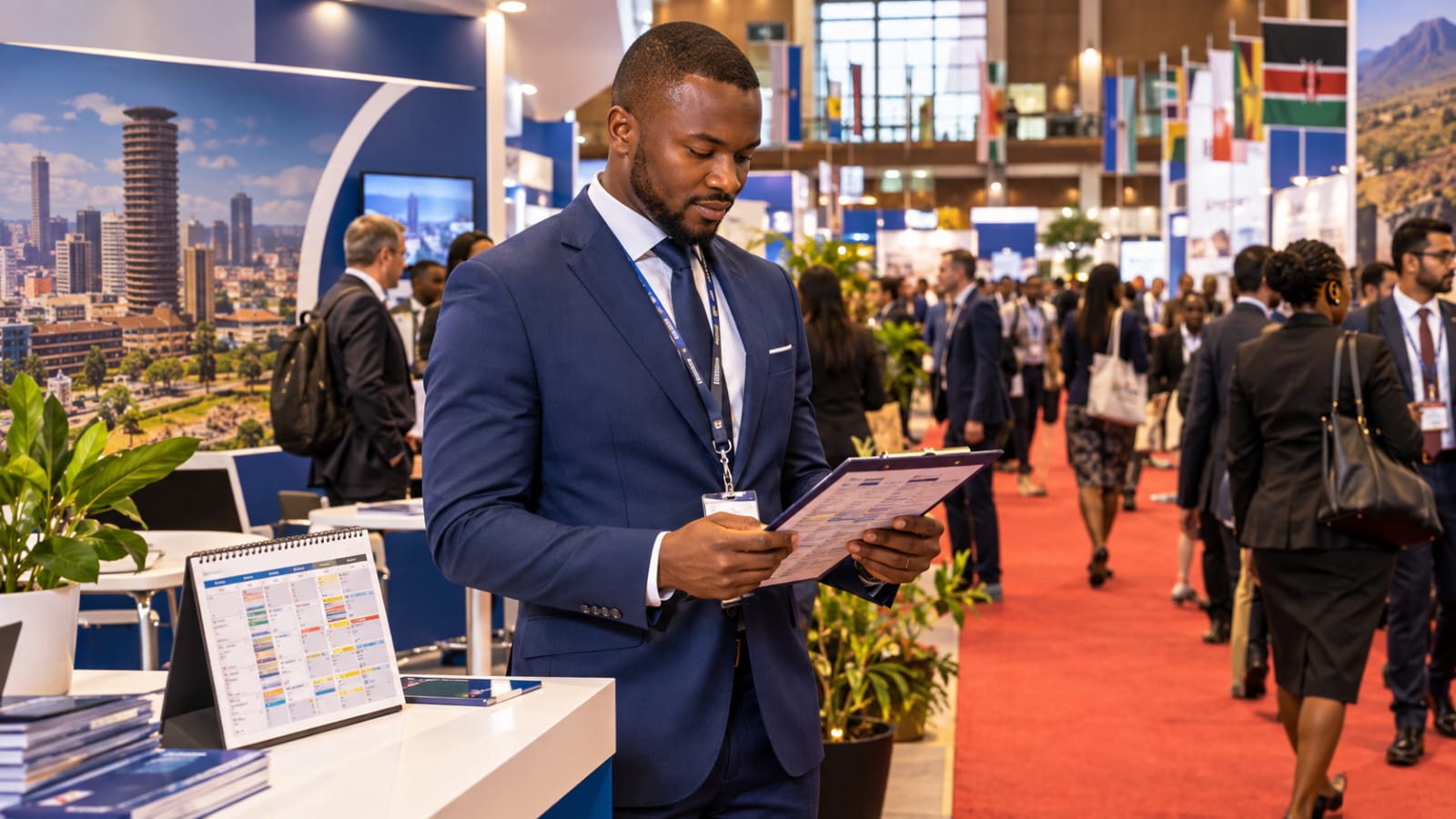

From Empty Footfall to Qualified Pipeline: The Practical Guide to Turning Kenya Events Into Commercial Revenue
A trade fair stand is not a strategy. It is the midpoint of a commercial campaign. The companies that leave Kenya exhibitions with pipeline are not the ones with the biggest stands — they are the ones who started the work weeks before the doors opened.
A trade fair is one of the most expensive moments in your East Africa market-entry journey — and one of the easiest to measure badly. You can count visitor footfall, badge scans, business cards collected, brochures distributed, and conversations held. But none of those numbers tells you whether the exhibition created genuine commercial value.
The real question is different: did the event put you in front of the right buyers, distributors, partners, and decision-makers, and did those conversations continue productively after the doors closed?
For international companies exhibiting in Kenya, that question rarely gets the answer it deserves. The stand gets booked, the stand gets built, the team flies in — and the commercial infrastructure that should be generating qualified meetings before the first visitor arrives simply does not exist.
This guide covers everything that needs to happen before, during, and after a trade fair in Kenya to convert your exhibition investment into measurable pipeline — including the pre-event outreach system, the onsite qualification framework, the 72-hour follow-up window, and the LeadWhizz services that make all of it work without requiring your team to build it from scratch.
The Real Cost of Exhibiting Unprepared in Kenya
Before the strategy, the numbers. Here is what a typical international exhibition in Nairobi actually costs — and what it too frequently fails to produce without a pre-event and post-event commercial system:
| Exhibition Cost Item | Typical Range | Why It Matters |
| ✈️ Return flights (2 people, Europe/Asia/Middle East) | $3,600–$7,000 | The largest fixed cost — and one that produces zero commercial return without a qualified meeting programme |
| 🏨 Hotel, 5 nights, Nairobi business district | $1,500–$3,600 | Non-negotiable logistics cost — only justified by the commercial conversations that fill the days |
| 🏢 Exhibition stand rental, medium 9–12sqm | $3,000–$8,000 | Visibility without a pre-arranged meeting strategy is the most expensive form of hoping |
| 📦 Freight, stand build, materials, display | $2,000–$6,000 | Often the most underestimated cost — especially for exhibitors shipping product samples |
| 📋 Visas, travel insurance, logistics | $500–$1,000 | Operational necessity — frequently forgotten in the initial budget estimate |
| 👥 Staff time, 2 people × 5 days away from primary market | Real but uncounted | Opportunity cost that never appears in the post-event budget but always appears in the post-event debrief |
| CONSERVATIVE TOTAL FOR 2 PEOPLE | $10,600–$25,600+ | Per exhibition. Before the LeadWhizz pre-event and follow-up system. After it: this investment produces pipeline. |
| 72 hours The window after a Kenya trade fair during which your contacts are still warm. After 72 hours, competing suppliers fill the inbox and the conversations you had begin to fade. Most exhibitors send their first follow-up 2–3 weeks later. |
| 40–60% LeadWhizz’s average email open rates on localised East Africa B2B outreach campaigns — significantly above global B2B email benchmarks, because every message is verified, targeted, and culturally calibrated. |
The gap between what most exhibitors invest and what they recover is not a Kenya market problem. It is a preparation and follow-through problem. The same exhibition floor that produces nothing for an unprepared exhibitor produces signed distribution agreements for a prepared one. The difference is the commercial system that runs before, during, and after the event.
The exhibitors who leave Nairobi with distribution agreements and qualified pipeline are not the ones who relied on foot traffic to deliver the right people. They are the ones who identified those people weeks earlier and made sure they were already booked before the stand went up.
The Kenya and East Africa Trade Fair Calendar: Where LeadWhizz Works
Kenya’s Nairobi-based trade fair calendar is one of the most active in sub-Saharan Africa — drawing buyers and distributors from across East and Central Africa to events that span every major B2B sector. Here are the exhibitions where LeadWhizz provides pre-event outreach, onsite support, and post-event follow-up:
Each of these exhibitions draws buyers and distributors from multiple East African markets — meaning your stand in Nairobi is not just a Kenya conversation. It is a potential conversation with procurement decision-makers from Uganda, Tanzania, Rwanda, Ethiopia, and beyond, all in one building for two or three days.
📌 Kenya’s trade fair calendar makes Nairobi the single most efficient venue in East Africa for meeting regional buyers in person. A well-supported exhibition at KICC or Sarit Expo Centre reaches a buying audience from 5+ countries simultaneously — making the pre-event targeting and post-event follow-up investment particularly high-leverage.
A Stand Is Not a Strategy — Why the Exhibition Must Be the Midpoint
The most common and most costly exhibition mistake international companies make in Kenya is treating the trade fair as the strategy. The exhibition is not the strategy. The exhibition is the midpoint of a three-phase commercial campaign.
Every year, international exhibitors fly into Nairobi, book prime floor space, ship products and promotional materials, deploy staff, and spend several days at major exhibitions — only to return home with a stack of unqualified business cards and no follow-up infrastructure. The problem is not the trade fair. The problem is everything that was not done before the doors opened and everything that was not done after they closed.
For a company exhibiting in Kenya, the campaign structure should look like this:
- Weeks before the exhibition: identify verified targets, conduct pre-event outreach, confirm meeting slots
- During the exhibition: qualify every conversation, document next steps, build the post-event follow-up queue
- Within 48 hours of the show closing: deploy personalised, segmented follow-up before contacts go cold
The stand is the moment when warm prospects — already introduced to your brand through pre-event outreach — have a face-to-face conversation that confirms the relationship. It is the most valuable hour of the campaign. But it is only valuable if the 4 weeks before and the 72 hours after are also executed.
Phase 1: Pre-Event Lead Generation — The Highest-Leverage Investment
Pre-event outreach is the phase that most exhibition budgets do not include — and the phase that determines whether the exhibition produces pipeline or just activity. Here is what a strong pre-event campaign for a Kenya trade fair includes:
Target Account Identification
The starting point is a precise commercial brief: what are you selling, who buys it in Kenya and East Africa, which sectors and company sizes matter, what type of relationship are you seeking — buyer, distributor, importer, technology partner, or joint venture — and what would make a meeting commercially valuable rather than interesting.
From this brief, LeadWhizz builds a verified target list from our 3M+ East Africa B2B database — every contact confirmed active, in role, and matched to your specific commercial profile. The list includes named decision-makers, not just company names.
Personalised Pre-Event Outreach
The outreach to each target is personalised — a specific reason why meeting this exhibitor at this exhibition is relevant to their current procurement or partnership objectives. Generic mass invitations to ‘visit our stand’ produce minimal response. Personalised, contextualised invitations explaining why the meeting is specifically relevant produce confirmed bookings.
Outreach channels: email, WhatsApp, and phone calls from local Kenyan numbers — the combination that consistently produces the highest response rates in the East African B2B context.
Meeting Booking and Confirmation
Confirmed meeting slots are loaded into the exhibitor’s daily schedule before departure — specific times, stand location, and the name and role of the confirmed attendee. Pre-event reminders are sent to reduce no-shows. The exhibitor lands in Nairobi with a calendar that is already commercially productive from Day 1.
⏱️ LeadWhizz recommends beginning pre-event outreach at least 4–6 weeks before the exhibition opens. For major exhibitions, 6–8 weeks allows sufficient time to reach senior decision-makers whose calendars fill early. Outreach begun fewer than 3 weeks before the exhibition opening date consistently produces lower meeting quality and higher no-show rates.
Phase 2: Onsite Lead Capture and Qualification
Once the exhibition opens, the objective shifts from awareness-building to commercial intelligence-gathering. A busy stand can generate hundreds of interactions in three days — but without a qualification system, those interactions produce a pile of undifferentiated contacts rather than a qualified pipeline.
The qualification framework should be consistent, simple enough for stand staff to apply in every conversation, and specific enough to capture the information needed for intelligent post-event follow-up. Here is the LeadWhizz qualification framework adapted for Kenya trade fair exhibitions:
| Qualification Question | Why It Matters | What to Do With the Answer |
| What problem or need are you solving? | Reveals the buying trigger — whether they are actively searching or just browsing. Active searchers are hot leads. | Segment by urgency — hot, warm, cold |
| What is your expected timeline? | Separates immediate buyers from future prospects. Determines follow-up priority and sequence. | Hot: follow up within 24 hours. Warm: follow up within 72 hours. Cold: 60-day nurture. |
| Who else is involved in the purchasing decision? | Identifies the full buying committee. In Kenya, 6–10 stakeholders typically involved in B2B purchases. | Flag multi-stakeholder deals for relationship mapping post-event |
| What volume or project size are you considering? | Validates commercial fit. Avoids wasting post-event follow-up resource on contacts below minimum viable order. | Qualify out contacts that don’t meet minimum commercial threshold |
| Are you looking for a supplier, distributor, or partner? | Defines the nature of the relationship. A buyer and a distributor require entirely different follow-up sequences. | Route to correct post-event track — supply chain or distribution pipeline |
| What is the agreed next step? | The single most important question. Every conversation should end with a specific, agreed, documented next action. | Lock in next step before they leave the stand — not after they return to their office |
The output of a well-run onsite qualification process is not a business card pile. It is a segmented pipeline — hot prospects ready for immediate post-event engagement, warm contacts for a structured follow-up sequence, and cold contacts for a longer-term nurture programme. That segmentation determines everything that happens in the 72 hours after the show closes.
Phase 3: Post-Event Follow-Up — Where Exhibition ROI Is Won or Lost
The exhibition does not end when the stand closes. In most cases, what happens in the 72 hours after the exhibition determines whether the entire commercial investment produces pipeline or produces a report.
The 72-Hour Window
For 72 hours after a Kenya trade fair, your exhibition contacts are warm. They remember the conversation. They have a positive impression of your brand. They are open to a next step.
After 72 hours, the warmth fades. Competing suppliers fill their inboxes. The show they attended becomes one of several trade events they attended this season. Your company becomes one of dozens they spoke to. The specific conversation you had becomes harder to recall.
Most international exhibitors send their first follow-up 2–3 weeks after the event closes. By that point, the window is functionally closed.
LeadWhizz deploys post-event follow-up within 24–72 hours of the last exhibition day — before that window closes — using the qualification notes captured onsite to personalise every message.
Segmented Follow-Up: The Right Message for the Right Contact
- Hot leads — high interest, decision-making authority, specific requirement discussed: personalised email referencing the exact conversation, WhatsApp follow-up the same day, and a meeting booking link or quotation proposal within 24 hours
- Warm leads — genuine interest but longer timeline or more stakeholders involved: value-add email within 48 hours, phone call from a local Kenyan number within 5 business days, structured touchpoint sequence over the following 4 weeks
- Cold leads — minimal conversation, unclear buying intent: enter a 60-day nurture sequence with educational content and periodic professional touchpoints rather than immediate commercial pressure
- Distributor or partner prospects: a separate, relationship-focused sequence acknowledging the longer decision timeline and building personal credibility before commercial discussion
The rule that applies across all segments: every follow-up references the specific conversation held at the stand. A generic ‘great to meet you at the exhibition’ email is the fastest way to signal that you did not pay attention. A personalised message that references what was discussed signals professionalism and genuine interest — the two things Kenyan B2B buyers need to see in the first follow-up from an international supplier.
The LeadWhizz 7-Phase Trade Fair Lead Generation System
Here is the complete LeadWhizz process for trade fair lead generation in Kenya and East Africa — from initial brief to pipeline report:
| # | Phase | What It Is | What LeadWhizz Does | Commercial Objective |
| 1 | BRIEF | Mission and profiling | Exhibitor brief — sector, product, target buyer profile, entry mode goal, and exhibition dates. | Define the ideal prospect. Align commercial objectives before any outreach begins. |
| 2 | TARGET | Verified database build | Identify and verify relevant buyers, distributors, importers, and decision-makers from 3M+ East Africa B2B contacts. | Build a focused, verified target list matched to the exhibitor’s commercial profile. |
| 3 | OUTREACH | Pre-event campaign | Personalised email, WhatsApp, and phone outreach from local Kenyan numbers — weeks before the exhibition opens. | Create qualified pre-booked traffic. The stand has commercial purpose before Day 1. |
| 4 | BOOK | Meeting confirmation | Coordinate confirmed meeting slots at the stand. Pre-event reminders sent to reduce no-shows. | Turn prospect interest into confirmed, scheduled appointments on the exhibition floor. |
| 5 | QUALIFY | Onsite lead capture | Capture needs, authority, timeline, volume, and agreed next step for every stand conversation. | Separate genuine commercial opportunities from casual contacts. Every conversation documented. |
| 6 | FOLLOW-UP | 48-hour post-event campaign | Personalised follow-up via email, WhatsApp, and phone within 24–72 hours of the exhibition closing. | Convert event contacts into pipeline before the warmth fades and competitors fill the inbox. |
| 7 | REPORT | Pipeline and KPI reporting | Meetings held, leads qualified, interest levels, next steps agreed, pipeline value, cost per meeting. | Make exhibition ROI measurable. Justify future participation with commercial evidence. |
Remote and Hybrid Exhibition Participation
Not every international company can send a full team to every Kenya exhibition. LeadWhizz’s commercial support infrastructure makes remote and hybrid participation commercially viable in a way that most exhibitors do not realise is possible.
For remote participation — where the company is not physically present but wants to generate commercial intelligence and buyer interest from the exhibition’s attendee pool — LeadWhizz runs the pre-event outreach and meeting facilitation programme entirely locally, producing a qualified prospect list and meeting recordings or notes for the remote company to engage from their home market.
For hybrid participation — a local representative or small team at the stand, with the senior team engaging remotely for specific high-value meetings via video — LeadWhizz provides onsite qualification support, meeting coordination, and ensures the stand operates with the same commercial rigour as a fully staffed team.
This model also serves as the most cost-effective way for an international company to test market interest in Kenya before committing to a larger exhibition presence. The commercial intelligence produced from a remote participation campaign — who responded, at what level, in which sector, with what buying intent — is the validated demand data that justifies a full exhibition investment in the following year.
Who Is This Service For?
LeadWhizz’s trade fair lead generation and event marketing service is designed for every stakeholder in the Kenya exhibition ecosystem:
- International companies exhibiting at trade fairs in Kenya and East Africa — seeking pre-booked B2B meetings rather than relying on walk-in foot traffic
- Companies entering the Kenyan market looking for buyers, distributors, wholesalers, or commercial partners at a specific sector exhibition
- Exhibitors participating remotely or through a local partner — who need local commercial infrastructure without a full travelling team
- Trade fair organisers and national pavilion coordinators seeking stronger exhibitor commercial outcomes for their participants
- Embassies, trade promotion agencies, and chambers supporting companies at Kenya regional exhibitions
- Companies that attended a past Kenya exhibition without adequate pre-event and post-event systems and want to correct that for the next one
| 🎪 Exhibiting at a Trade Fair in Kenya or East Africa? Do not wait until the exhibition doors open to start looking for buyers. Here is exactly what happens when you contact LeadWhizz: 📞 Step 1: Contact LeadWhizz — by email or via our website 📅 Step 2: We respond within 48 hours to schedule your Free Discovery Call 🔍 Step 3: On the call, we map your exhibition, your sector, your target buyer or distributor profile, and the commercial objective you need the show to deliver 📊 Step 4: Within 48 hours you receive your Free Campaign Audit — a pre-event outreach plan, verified target account landscape, and recommended post-event follow-up strategy for your exhibition 🚀 Step 5: We build your pre-event outreach campaign, deliver confirmed meetings before you arrive, support on-ground qualification, and deploy your post-event follow-up within 48 hours of the show closing The Discovery Call is FREE. The Campaign Audit is FREE. Tell us which fair you are considering, what you sell, and who you want to meet. We will build the commercial programme around your exhibition. Verified Leads. Measurable Growth. Guaranteed Results. 📩 b2b@leadwhizz.africa | www.leadwhizz.africa |
Frequently Asked Questions
Q: How far in advance should trade fair lead generation start?
LeadWhizz recommends beginning pre-event outreach 4–6 weeks before the exhibition for most Kenya trade fairs. Starting fewer than 3 weeks before the exhibition opening date consistently produces lower meeting quality and higher no-show rates. If you are reading this within 3 weeks of your exhibition, contact us immediately — we will assess what is achievable within the remaining window and build the best possible programme.
Q: Can LeadWhizz generate meetings before the exhibition starts?
Yes — pre-event meeting booking is the core of the LeadWhizz trade fair service. We identify relevant buyers, distributors, importers, and decision-makers from our verified East Africa B2B database, conduct personalised outreach, and book confirmed meeting slots at your stand before the exhibition opens. The exhibitor arrives in Nairobi with a meeting calendar that is commercially productive from Day 1 — without relying on foot traffic to deliver the right people.
Q: Can LeadWhizz help me find distributors specifically at a Kenya trade fair?
Yes — distributor identification is one of the most common objectives we support at Kenya exhibitions. Before the event, we identify distributors in your sector and geography with the right portfolio fit, distribution infrastructure, and genuine interest in expanding with international brands. At the event, we facilitate structured conversations covering territory, product fit, purchasing volumes, and current customer base. After the event, we deploy a distributor-specific follow-up sequence that respects the longer decision timeline that distribution partnership evaluation requires in Kenya.
Q: What if our team is not travelling to Kenya — can LeadWhizz still help?
Yes. LeadWhizz provides local commercial support for remote and hybrid participation — and this is one of our fastest-growing service areas. For remote participation, we run pre-event outreach and generate a verified prospect list and meeting notes for your team to engage from your home market. For hybrid participation, we provide onsite qualification support and meeting coordination for a small local team or representative. This model is also the most cost-effective way to test market interest in Kenya before committing to a full exhibition investment.
Q: Which trade fairs in Kenya does LeadWhizz actively support?
LeadWhizz supports pre-event outreach, onsite lead generation, and post-event follow-up across all major B2B trade fairs in Kenya, including: Propak East Africa, Intersolar East Africa, Big 5 Construct Kenya, AFMASS Food Expo, MEDEXPO, the Nairobi International Trade Fair, Autoexpo Kenya, GITEX Kenya, Beauty Kenya, and Power & Energy Kenya. The same framework applies to exhibitions in Tanzania, Rwanda, Uganda, and Ethiopia for companies attending multi-country B2B events.
Q: How do you measure whether the campaign worked?
LeadWhizz’s post-exhibition reporting covers: target accounts identified and verified, decision-makers reached before the event, pre-booked meetings confirmed and held, qualified leads captured onsite, leads segmented by interest and buying role, RFQ and next-step requests, distributor or partner opportunities identified, follow-up completed within the agreed 24–72 hour window, pipeline value where the information is available, and cost per qualified meeting. The exact reporting framework is agreed before the outreach campaign begins — so there is no ambiguity about what success looks like.
Q: What happens to the leads after the trade fair?
LeadWhizz deploys structured post-event follow-up within 24–72 hours of the exhibition closing — using the qualification notes captured onsite to personalise every message. Hot leads receive a direct commercial proposal or meeting booking link the same day. Warm leads receive a professional follow-up email and a phone call within 5 business days. Cold leads enter a 60-day nurture sequence. Every follow-up references the specific conversation held at the stand — because a generic ‘great to meet you’ email is the fastest way to lose the value of a warm exhibition contact in a relationship-first market like Kenya.
Leave a Reply