
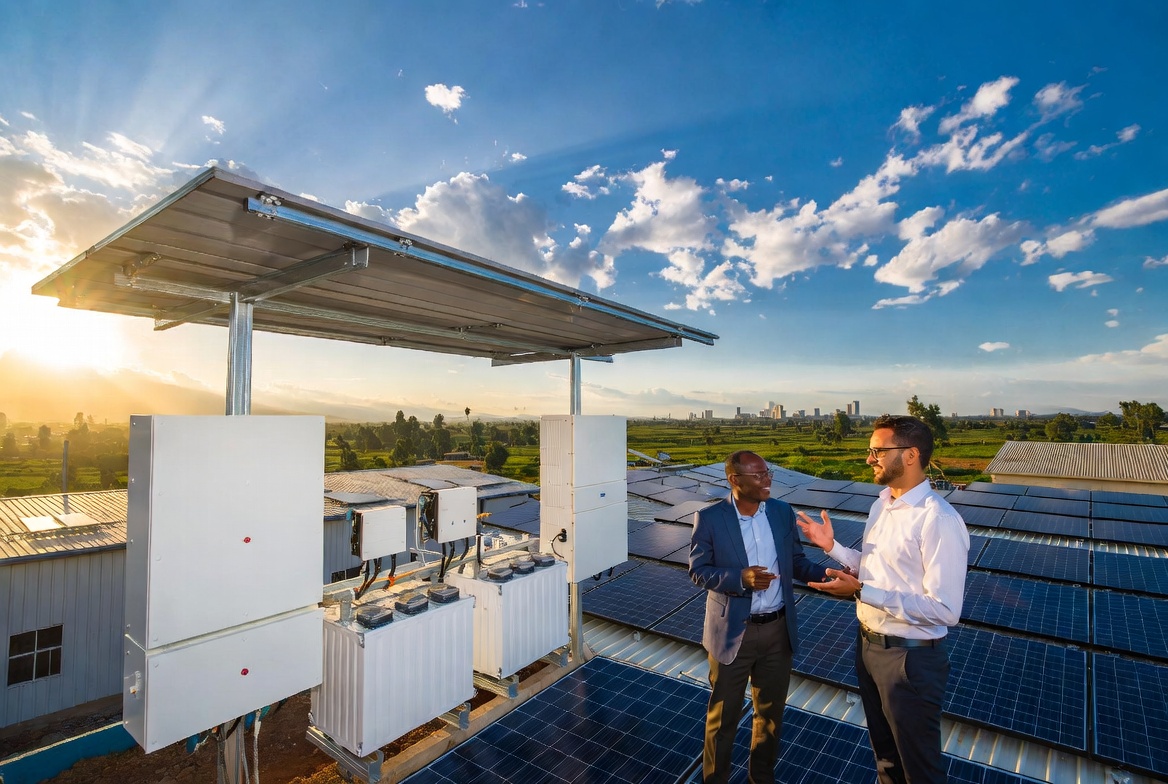

How to Find Verified Distributors, Installers and Project Buyers Without a Local Sales Office
Kenya imported nearly 1.4 gigawatts of solar PV technology in a single month in 2026 — one of the strongest renewable energy surges anywhere in East Africa. For international solar panel, inverter and power equipment manufacturers, that number is not a curiosity. It is a market signal that the door is wide open right now.
Here is the scenario that plays out for manufacturer after manufacturer trying to enter this market:
A solar panel, inverter, or battery storage brand sees Kenya’s renewable energy growth and the country’s well-publicised target of a 100% clean energy grid, and identifies it as a priority market. The team prepares technical datasheets, a price list, and a list of distributor and installer contacts pulled together from public directories and old exhibition badges. They start reaching out.
Then the response rate collapses.
Emails to general sales addresses go unanswered. A distributor who seemed promising turns out to be reselling a single competing brand exclusively. A government rural electrification tender is discovered only after the submission window has closed. Meanwhile, low-cost imports, many from a handful of dominant Asian manufacturers who have flooded the market for years, continue to win the bulk of price-sensitive distributor relationships, while local EPC installers default to brands they already know and trust.
This is not a product or pricing problem on its own. It is a visibility, trust, and timing problem,and it is entirely solvable with the right local intelligence, the right outreach sequencing, and the right partner who understands how Kenya’s solar supply chain actually works.
This guide breaks down exactly how international solar panel, inverter and power equipment manufacturers are building verified buyer and distributor pipelines in Kenya in 2026, covering off-grid, commercial and mini-grid segments, without the cost of a local office or months of trial and error.
LeadWhizz by the Numbers: Proven B2B Results Across Africa
Before the strategy, the evidence. LeadWhizz has supported international manufacturers across multiple industries, including solar and renewable energy equipment, in finding qualified distributors, installers, and project buyers across Africa.
| 3M+ | 15+ | 20+ | 40–60% | Weeks |
| Verified business leads across Africa | Countries reached with East Africa specialisation | Industries supported — including solar and renewable energy | Average email open rates on Kenyan B2B campaigns | Qualified introductions delivered — not months |
These results reflect real engagements across renewable energy, construction, automotive, healthcare, FMCG, and manufacturing, across Kenya and the wider East African region.
Market Snapshot: Kenya’s Renewable Energy Boom in 2026
Kenya already generates the vast majority of its electricity from renewable sources, geothermal, hydro, wind and solar together account for roughly 90% of installed capacity, and the country has set an ambitious target of reaching a 100% renewable energy grid by 2030. Solar’s share of that mix is growing quickly: the country imported close to 1.4 gigawatts of solar PV technology in a single month in 2026 alone, one of the strongest surges recorded anywhere in East Africa, with a large share consisting of solar cells rather than fully assembled panels, signalling growing interest in local assembly capacity as well as imports.
National electricity access has climbed from roughly a third of the population a decade ago to around 84% today, and the government’s strategy for closing the remaining gap leans heavily on decentralised solar, solar home systems and mini-grids, rather than costly grid extension into remote areas. Kenya has, as a result, become one of the most active standalone solar home system markets in the world, ranking as the second-largest such market globally after India, driven substantially by pay-as-you-go financing models that let households and small businesses pay for systems through mobile money in small instalments.
A few structural drivers are accelerating demand for imported solar and power equipment:
- Off-grid and rural electrification — government and donor-backed programmes continue to fund mini-grid and standalone solar deployment in underserved counties
- Commercial and industrial adoption — flower farms, tea factories, retail businesses and manufacturers are increasingly installing solar to cut diesel backup costs and improve reliability
- Battery storage growth — lithium-ion and hybrid systems are becoming a standard pairing with solar PV as businesses seek reliable power after sunset
- Favourable tax treatment — VAT and import duty exemptions on solar PV products continue to lower the cost barrier for new entrants and buyers alike
Key Buyer Sectors
- Distributors and importers — the primary route to market for panels, inverters and batteries, supplying installers and retailers nationwide
- EPC installers — engineering, procurement and construction firms that design and install residential, commercial and utility-scale solar systems
- Mini-grid and off-grid developers — companies building decentralised power systems for rural and underserved communities, often with donor or government backing
- Commercial and industrial buyers — flower farms, factories, hotels and retail chains purchasing solar and backup power systems directly for their own operations
Growth is concentrated in a recognisable set of categories: solar panels and cells, string and hybrid inverters, lithium-ion battery storage, and solar water pumping systems for agricultural use. Manufacturers entering with a category that maps clearly onto Kenya’s current demand mix have a significantly easier conversation with both distributors and installers.
Kenya’s renewable energy ambition is backed by real policy commitment and real import volume — which makes this one of East Africa’s most consistently underexploited B2B opportunities for solar and power equipment manufacturers.
Pain Points for Overseas Solar and Power Equipment Manufacturers
Kenya’s solar market is more regulated and more competitive than it first appears, and that combination creates specific challenges for manufacturers trying to enter remotely.
Regulatory Pathways
Solar equipment sold in Kenya falls under the oversight of the Energy and Petroleum Regulatory Authority (EPRA), which licenses generators, distributors and suppliers — including off-grid and mini-grid operators — and enforces national quality and safety standards for solar equipment developed in partnership with the Kenya Bureau of Standards. Manufacturers who treat compliance as an afterthought, rather than building it into their market entry plan from the outset, often find buyers stalling once they ask for proof of standards compliance partway through a sales conversation.
Intense Price Competition
Kenya’s solar panel market has been described by industry observers as flooded with low-cost imports, with a small number of dominant Asian manufacturers holding significant distributor mindshare built up over many years. Competing purely on price against suppliers with this level of entrenched relationship and volume advantage is rarely a winning strategy for a new entrant — differentiation has to come from quality assurance, warranty terms, technical support, or a specific product category where the market is underserved, such as battery storage or solar water pumping.
Identifying the Real Decision-Makers
Purchasing authority in Kenya’s solar sector varies by buyer type. In distributor businesses, a procurement or commercial director typically evaluates new suppliers; in EPC installer firms, a technical director or lead engineer often drives the brand selection even when a separate person signs the purchase order; in mini-grid developer organisations, decisions may involve donor or grant compliance requirements that add an extra layer of evaluation. Reaching a generic company email rarely reaches the person who actually selects suppliers, and without local insight, manufacturers have no reliable way of knowing who that person is for a given buyer.
Exhibition Competition
Kenya’s and the wider region’s solar trade exhibitions, including Intersolar Africa, attract a dense concentration of international exhibitors all competing for the attention of the same relatively small pool of distributors, installers and project developers. Without pre-event outreach, manufacturers compete purely on stand design and walk-up traffic against dozens of similar offers — and the conversations that do happen are rarely with anyone holding real budget authority for an active project.
None of these challenges are reasons to avoid the market. They are simply reasons why a structured, locally-informed entry strategy outperforms a generic export sales push — particularly in a sector where regulatory credibility, technical trust, and pricing positioning all matter as much as product quality.
Kenya’s Solar & Power Equipment Buyer Landscape
Each buyer segment in Kenya’s solar market has a different evaluation process, purchasing cycle, and decision-making structure. Tailoring your approach to each is essential to converting interest into actual purchase orders.
| Buyer Type | What They Do | Why It Matters |
| Distributors & Importers | Buy panels, inverters and batteries in bulk for resale to installers and retailers across the country | Fastest route to national reach without building direct installer relationships from scratch |
| EPC Installers | Design and install residential, commercial and utility-scale solar systems, often specifying the brand used | Strong influence over end-customer brand choice — high-value relationship to win |
| Mini-Grid & Off-Grid Developers | Build decentralised power systems for rural and underserved communities, often with donor or government funding | Large-volume, recurring procurement tied to programme funding cycles |
| Commercial & Industrial Buyers | Flower farms, factories, hotels and retail chains purchasing systems directly to cut diesel backup costs | High-value, direct-purchase accounts with strong reference value for future sales |
Distributors and EPC installers with existing buyer relationships are often the fastest entry point for manufacturers entering the market for the first time — they already carry the local credibility and technical trust that takes years to build independently.
The 6 Outreach Methods Manufacturers Try — And Why Most Underperform
1. Generic Email Blasts to Company Sales Addresses
Sending datasheets and price lists to general sales inboxes rarely converts. Distributors and installers receive a steady stream of unsolicited supplier pitches, particularly from manufacturers competing on price alone, and a generic email is easy to ignore.
2. Competing Purely on Price
Trying to undercut entrenched low-cost suppliers without offering verified quality, warranty terms, or a differentiated product category usually fails — Kenyan distributors already know where to find the cheapest panels, so price alone is rarely the deciding factor in switching suppliers.
3. Trade Shows Without Pre-Event Outreach
Exhibiting at a major solar trade show without booking meetings in advance means competing purely on stand traffic against a dense field of international exhibitors. Without scheduled meetings, the highest-value attendees — distributors and developers with active procurement plans — often walk past entirely.
4. Approaching Distributors Without Verification
Not every business claiming to be a solar distributor in Kenya has the warehousing, installer network, or after-sales service capacity to actually move product at scale. Signing an exclusive agreement with an unverified distributor can lock a manufacturer out of the market for years with little to show for it.
5. Underestimating EPRA and Standards Requirements
Manufacturers who begin outreach before confirming their product’s compliance with relevant EPRA and national solar equipment standards often find themselves with interested buyers but unresolved compliance questions late in the sales process — a frustrating and avoidable position that damages credibility with buyers who were ready to commit.
6. One-Touch Outreach With No Follow-Up Sequence
A single email or call rarely converts a distributor or installer into a buyer. Purchasing decisions in this sector often involve multiple stakeholders and technical evaluation cycles, and manufacturers who give up after one unanswered message leave the door open for a competitor with a more persistent, structured follow-up approach.
Effective B2B Lead Generation Tactics That Actually Work
Build Targeted, Verified Lists by Buyer Type
Segmenting your target list by distributor, EPC installer, mini-grid developer, and commercial buyer — rather than treating ‘solar buyers’ as one undifferentiated audience — allows each outreach sequence to speak directly to that buyer’s actual evaluation process. A verified list also means your outreach reaches confirmed, active businesses with real procurement budgets, not outdated directory entries.
Lead With Technical Specifications, Samples and Compliance
Solar buyers evaluate suppliers on technical performance and compliance as much as price. Outreach sequences that lead with clear product specifications, warranty terms, an offer of samples for testing, and visible EPRA-relevant standards compliance consistently outperform generic sales pitches. A distributor who receives a complete, professional information package is far more likely to take the conversation further than one who receives a vague introductory email.
Combine Email With Follow-Up Calls
Email alone has a low conversion rate with busy distributors and technical decision-makers. Following up an initial email with a phone call — confirming receipt, offering to answer technical questions, and establishing a realistic evaluation timeline — significantly increases the likelihood of a real conversation, and signals a level of professionalism that serious buyers associate with reliable suppliers.
Time Campaigns Around Intersolar Africa and Funding Cycles
Outreach timed to land a few weeks ahead of Intersolar Africa — offering to schedule a meeting at the event — converts far better than cold outreach at any other point in the year, because buyers are already anticipating supplier conversations. Similarly, tracking donor-funded off-grid and mini-grid programme announcements allows manufacturers to approach developers early in a funding cycle, before procurement decisions are finalised.
In Kenya’s solar market, the manufacturer who is already a known, credible name before a distributor’s next stock order or a developer’s next funding round wins more often than the manufacturer with the lowest quoted price.
Outreach Methods Compared
| Method | Cost | Speed | Success Rate |
| Generic email blast | Low | Slow | Very Low |
| Competing purely on price | Low | Slow | Low |
| Trade show — unplanned | High | Slow — months | Low |
| Unverified distributor agreement | Medium | Variable | Variable |
| Intersolar Africa + LeadWhizz pre-event outreach | Medium | Fast — weeks | High |
| LeadWhizz verified B2B campaign | Efficient | Fastest | Very High |
Regulatory and Standards Considerations by Category
Understanding the regulatory context around your specific product category prevents one of the most common causes of stalled deals: an interested distributor who cannot get your product cleared for sale or installation.
| Category | Key Requirement | Risk If Ignored |
| Solar Panels & Cells | National quality and safety standards for solar PV equipment, plus import documentation | Shipment holds at port or rejection by quality-conscious distributors |
| Inverters | Compliance with relevant electrical safety and performance standards | Installer hesitancy to specify uncertified inverters on customer projects |
| Battery Storage | Safety certification and environmental handling requirements for lithium-ion systems | Clearance and distribution restrictions if non-compliant |
| Mini-Grid & Off-Grid Systems | EPRA licensing framework under the Energy (Mini-Grid) Regulations for generators, distributors and suppliers | Ineligibility to supply licensed mini-grid or off-grid developers |
Partnering with a distributor or installer who already understands these requirements — and who holds the relevant EPRA standing where applicable — is one of the most effective ways to de-risk early-stage market entry, particularly for mini-grid and off-grid categories where the regulatory framework is more involved.
Real-World Application: From Lead to Order
Generating interest is only the first step. Converting a qualified lead into a signed purchase order in Kenya’s solar market typically follows a structured path:
- Step 1 — Initial contact and qualification: confirm the buyer type, current supplier relationships, and realistic purchasing timeline before investing further effort
- Step 2 — Technical and compliance review: the buyer’s technical team evaluates specifications, warranty terms, and standards compliance against project or stocking requirements
- Step 3 — Sample or pilot installation: many buyers require a sample batch or a pilot installation before committing to a larger order or distribution agreement
- Step 4 — Internal approval: the buyer’s procurement lead, technical director, or — for donor-funded projects — programme compliance team formally evaluates the proposal
- Step 5 — Negotiation and purchase order: pricing, payment terms, delivery schedule, and warranty or after-sales support are finalised before the order is confirmed
Common Objections and How to Overcome Them
- “We’ve never heard of your brand” — address with verified references, standards certification, and an offer of a no-obligation sample for testing
- “Your price is higher than the Chinese suppliers we already use” — reframe around total cost of ownership, including warranty support, failure rates, and after-sales service availability
- “We need local technical support and warranty service” — partnering with a local distributor or installer who can commit to service-level agreements directly addresses this concern
- “We’re locked into a current supplier relationship” — build the relationship now so your company is already known and credible when that relationship eventually needs to expand or diversify
- “We need to see this installed on another project first” — prioritise securing one strong reference installation, even at a reduced margin, to unlock subsequent sales
From Cold Market to Signed Distributor: A Realistic Scenario
Consider a mid-sized European inverter and battery storage manufacturer entering East Africa for the first time. Initial efforts — generic emails to general distributor sales addresses — generated almost no replies over several weeks, and the team had no reliable way to confirm which distributors were actively expanding their product range.
After shifting to a verified-database and multi-channel approach, the outreach team identified 28 active solar distributors and EPC installers expanding into battery storage and hybrid systems, along with two mini-grid developers running active donor-funded electrification programmes. Personalised outreach combining email, follow-up calls, and a sample testing offer led to 10 qualified meetings within five weeks — each one with a procurement director, technical lead, or developer principal holding real purchasing authority.
Two EPC installers committed to pilot installations following successful sample testing, and one distributor agreement was signed covering nationwide distribution with a committed technical support arrangement. The manufacturer used the resulting reference installations to strengthen positioning ahead of a subsequent mini-grid programme tender, where having existing in-market references and a verified local distributor measurably strengthened their credibility. The difference wasn’t the product — it was the structure, sequencing, and persistence of the outreach.
The most reliable path to market entry in Kenya’s solar sector is through verified introductions and a structured follow-up sequence — not a single email and hope.
LeadWhizz’s Role: Database Building, Outreach and Matchmaking
LeadWhizz does not simply deliver contact lists. LeadWhizz acts as an operational extension of your business inside Kenya — combining verified lead intelligence, localised outreach, and relationship facilitation into a complete remote market entry system built specifically for solar panel, inverter and power equipment manufacturers.
- Verified contacts across distributors, EPC installers, mini-grid developers and commercial buyers — every contact confirmed active and accurately attributed before it reaches your outreach list
- Custom databases tailored to your specific product category — panels, inverters, battery storage, or solar water pumping systems
- Full outreach execution across email, phone and WhatsApp, sequenced to match how Kenyan solar buyers actually evaluate new suppliers
- Exhibition and funding-cycle timing guidance, including pre-event outreach ahead of Intersolar Africa and early positioning with donor-funded mini-grid developers
- Matchmaking with verified distributors and installers who already hold EPRA-relevant standing and established buyer relationships, where direct entry is not the right first step
Why LeadWhizz Outperforms Generic Outreach
| ❌ Generic Outreach | ✅ LeadWhizz Approach | 📈 Business Impact |
| Generic emails to general sales addresses | Verified contacts at procurement and technical-lead level | Messages reach people with real purchasing authority |
| No regulatory or standards guidance | EPRA and national standards awareness built into outreach | Fewer stalled deals due to compliance gaps |
| Unverified distributor partnerships | Distributors screened for installer networks and service capacity | Reduced risk of exclusive agreements that go nowhere |
| Single-touch outreach with no follow-up | Structured multi-touch sequences with calls and sample offers | Higher conversion from lead to qualified meeting |
| No exhibition strategy | Pre-Intersolar Africa outreach and scheduled meetings | Higher ROI on exhibition travel and stand costs |
Your Kenya Solar & Power Equipment Market Entry Checklist
- A verified, segmented contact database — distributors, EPC installers, mini-grid developers and commercial buyers
- Clarity on relevant EPRA and national standards requirements for your product category before outreach begins
- A multi-touch outreach sequence combining email, follow-up calls and sample or pilot installation offers
- Awareness of Intersolar Africa timing and active donor-funded off-grid or mini-grid programme cycles
- A short list of objection-handling responses prepared for common procurement pushback, especially on price
- At least one reference installation strategy — even at reduced margin — to unlock subsequent sales
- A local distributor or installer partner with EPRA-relevant standing and service infrastructure, where direct entry is not the right first step
☀️ Start Building Verified Solar Buyer Relationships in Kenya Today
No flights. No local office. No costly trial and error.
Here is exactly what happens when you reach out:
- Step 1: Contact LeadWhizz — by email or via our website
- Step 2: We respond within 48 hours to schedule your Free Discovery Call
- Step 3: On the call, we map your product category, regulatory requirements, and target buyer segments
- Step 4: Within 48 hours you receive your Free Kenya Solar Buyer List Consultation
- Step 5: We identify, qualify, and connect you with verified distributors, installers and buyers — so your first conversation is a warm one
The Discovery Call is FREE. The Solar Buyer List Consultation is FREE.
Verified Leads. Measurable Growth. Guaranteed Results.
📩 b2b@leadwhizz.africa │ www.leadwhizz.africa
Frequently Asked Questions
Q: How long does it take to find qualified solar equipment buyers in Kenya through LeadWhizz?
LeadWhizz typically delivers a shortlist of verified, qualified buyers within 2 to 4 weeks of engagement starting, with first conversations happening within 3 to 6 weeks — significantly faster than relying on unplanned trade show attendance or cold outreach alone.
Q: Do I need EPRA approval before LeadWhizz can start outreach on my behalf?
Outreach and relationship-building can begin before formal approval processes complete, since many distributors and installers want to evaluate product fit before compliance paperwork is finalised. However, having clarity on the relevant EPRA and standards requirements for your category early helps set accurate expectations with buyers and avoids stalling deals later.
Q: How does LeadWhizz help manufacturers compete against low-cost Asian suppliers?
LeadWhizz focuses outreach on the buyers and categories where differentiation beyond price genuinely matters — distributors and installers prioritising warranty support, certified quality, and after-sales service, and underserved categories like battery storage and solar water pumping where competition is less saturated.
Q: Which solar and power equipment categories does LeadWhizz cover in Kenya?
LeadWhizz builds verified buyer databases across solar panels, inverters, battery storage and solar water pumping systems, covering distributors, EPC installers, mini-grid developers and commercial buyers nationwide.
Q: Do you offer support around Intersolar Africa specifically?
Yes. LeadWhizz runs pre-event outreach campaigns timed ahead of Intersolar Africa, helping manufacturers arrive with scheduled meetings already booked rather than relying solely on stand traffic during the event.
Leave a Reply