
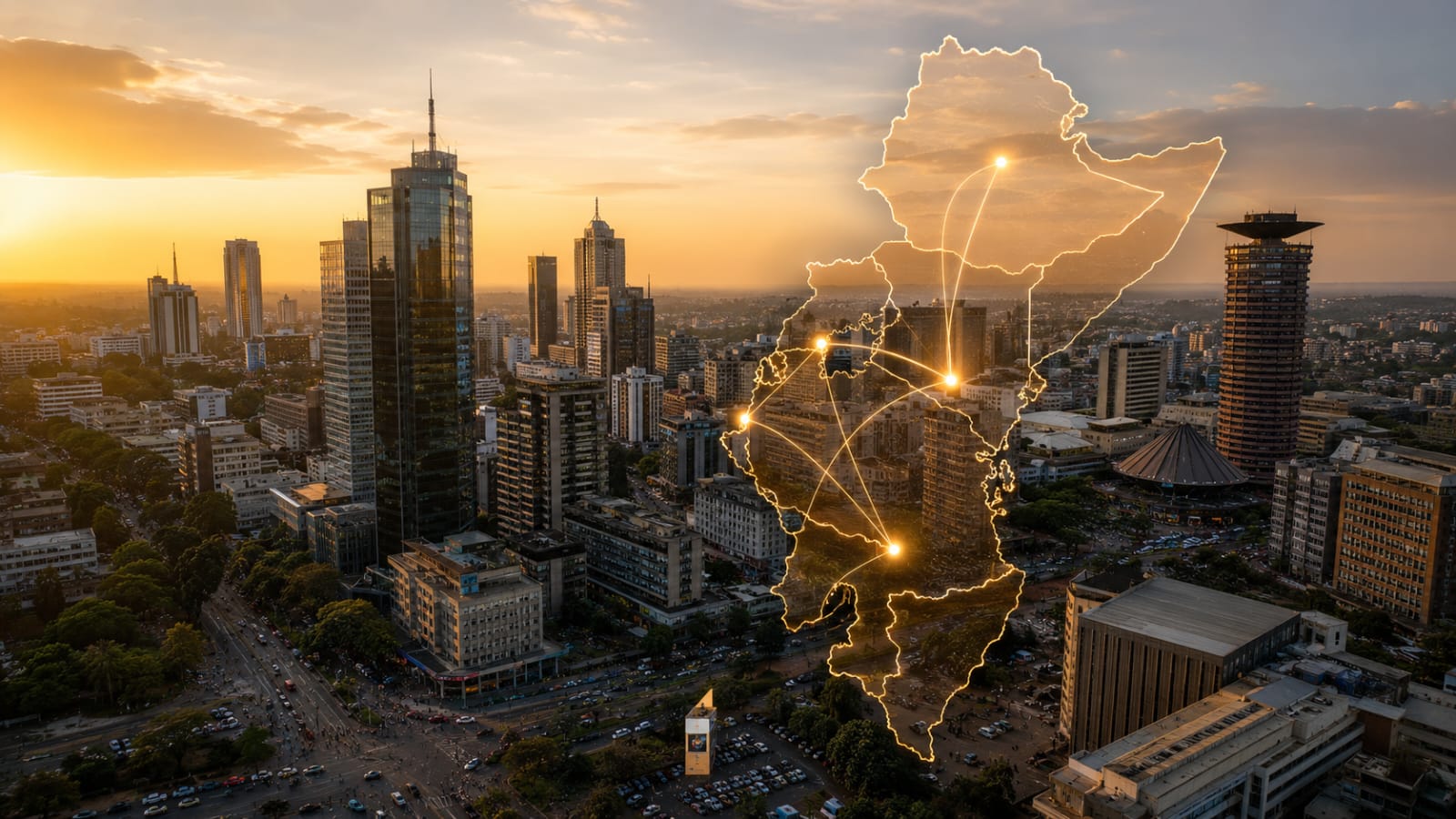

📊 Source: African Development Bank (AfDB) Macroeconomic Performance and Outlook (MEO) Report — released 30 March 2026 at AfDB headquarters, Abidjan, Côte d’Ivoire. This is the Bank’s official biannual economic assessment for policymakers, global investors, and development partners.
The African Development Bank has confirmed what B2B leaders in East Africa already knew. The question now is not whether to enter this market. It is whether you enter before your competitors do.
On 30 March 2026, the African Development Bank Group released its Macroeconomic Performance and Outlook (MEO) report, the continent’s most authoritative biannual economic assessment. The headline finding for B2B leaders was unambiguous:
East Africa is Africa’s fastest-growing region. It has been for years. And it is not slowing down.
With real GDP growth of 6.4% in both 2025 and 2026, more than double the global average of 3.1%, and comfortably ahead of every other African region, East Africa is not just a market with potential. It is a market in active, broad-based, sustained expansion.
For international companies with B2B ambitions in Africa, this report is not background reading. It is a commercial signal. And for companies already in the East African market, it is confirmation that the investment in building verified pipeline here is compounding on a foundation of genuine macro momentum.
This article breaks down exactly what the AfDB’s findings mean for B2B strategy, country by country, sector by sector and shows you precisely how LeadWhizz positions your business to capture the pipeline that this growth is generating right now.
The Headline Data: East Africa’s Growth in Perspective
Before the business strategy, the numbers. Because these are not estimates or projections by hopeful investors — they are the African Development Bank’s official, peer-reviewed findings:
6.4%
East Africa real GDP growth in 2025 — confirmed by AfDB MEO Report, 30 March 2026
Source: African Development Bank Group, Macroeconomic Performance and Outlook Report, 30 March 2026
6.4%
East Africa real GDP growth projected for 2026 — matching 2025 performance with no deceleration
Source: African Development Bank Group, Macroeconomic Performance and Outlook Report, 30 March 2026
2x+
East Africa’s growth rate vs. the global average — 6.4% vs. 3.1% world average in 2025
Source: AfDB MEO Report 2026. Global average: 3.1% in 2025.
12 of 20
of the world’s fastest-growing economies in 2025 were African — confirming Africa’s position as the global growth frontier
Source: African Development Bank Group, Macroeconomic Performance and Outlook Report, 30 March 2026
East Africa vs. Every Other African Region: The Full Picture
The AfDB’s findings don’t just confirm East Africa’s strength in isolation. They contextualise it against every other African region making the investment case impossible to argue with:
| African Region | 2025 GDP Growth | 2026 (Projected) | 2027 (Projected) | B2B Opportunity |
| 🏆 East Africa | 6.4% | 6.4% | 6.3% | Highest on continent |
| West Africa | 4.6% | 4.6% | ~4.6% | Second strongest |
| North Africa | 4.3% | 4.2–4.4% | ~4.3% | Strong, competitive |
| Central Africa | ~3.8% | 4.2% | 4.3% | Resources-led growth |
| Southern Africa | ~1.6% | ~2.0% | ~2.2% | Slowest on continent |
Source: African Development Bank Group MEO Report, 30 March 2026. Southern Africa figures from UN ECA Africa Economic Outlook January 2026.
The gap between East Africa and Southern Africa, the continent’s slowest-growing region, is not a minor performance difference. It is a structural divergence. Southern Africa faces persistent electricity shortages, logistics bottlenecks, and subdued export demand. East Africa is driven by infrastructure investment, services productivity, and post-recovery momentum across a diverse economic base.
For B2B leaders allocating market entry resources across Africa, this divergence is not academic. It is the most important capital allocation data available on the continent in 2026.
When the continent’s most authoritative economic institution says East Africa is growing at twice the global average — and doing so across the broadest possible base — that is not an opportunity to investigate. It is an opportunity to enter.
Country-by-Country: The B2B Opportunity Behind the Numbers
The AfDB’s report highlights specific country performers driving East Africa’s regional leadership. Here is what the growth figures mean for B2B strategy and what sector opportunities they signal for international companies:
| Country | GDP Growth | Key Growth Sectors | B2B Opportunity Signal |
| 🇪🇹 Ethiopia | 9.8% | Infrastructure, agriculture, manufacturing, digital services | Fastest-growing economy in the region — immense B2B procurement activity in construction, logistics, and energy |
| 🇺🇬 Uganda | 7.8% | Oil sector launch, agriculture, services, fintech | Strong services sector growth and emerging oil economy creating B2B supply chain opportunities |
| 🇷🇼 Rwanda | 7.3% | ICT, tourism, financial services, regional logistics hub | Africa’s most business-friendly environment — high ease of doing business, strong institutional frameworks |
| 🇹🇿 Tanzania | 6.1% | Mining, agriculture, logistics, construction, tourism | Dar es Salaam’s port expansion driving B2B logistics and distribution opportunities across landlocked markets |
| 🇰🇪 Kenya | EAC Hub | Fintech, logistics, technology, agriculture, services | East Africa’s largest, most mature economy — the gateway through which regional B2B strategy flows |
GDP growth figures: AfDB MEO Report, 30 March 2026. Rwanda figure as per AfDB (7.3%); earlier AFP/press reports cited 7.5% — AfDB official figure used throughout.
🇰🇪 Kenya context: While the AfDB report does not isolate a single growth figure for Kenya in the March 2026 MEO summary, Kenya is explicitly featured as the EAC’s largest and most diversified economy the commercial gateway through which regional investment strategy flows. Kenya’s position as East Africa’s financial, technology, and logistics hub means its growth trajectory directly benefits from and amplifies every percentage point of regional expansion.
What Is Driving East Africa’s Growth — and Why It Matters for B2B
The AfDB’s report identifies four structural drivers of East Africa’s regional growth leadership. Each one has direct implications for B2B market entry and pipeline strategy:
1. Sustained Infrastructure Spending
East Africa’s governments, led by Ethiopia, Rwanda, Kenya, and Uganda, have maintained high levels of infrastructure investment across roads, ports, railways, digital connectivity, and energy. For B2B companies, this translates into active procurement across construction materials, engineering services, logistics, technology, and utilities, sectors where qualified buyers are actively seeking international suppliers and partners.
- Ethiopia’s infrastructure programme is creating B2B procurement opportunities that are among the largest on the continent
- Tanzania’s Dar es Salaam Port expansion is generating significant logistics and supply chain B2B activity
- Kenya’s ongoing digital infrastructure investment, supported by the BETA agenda, is sustaining fintech, telecoms, and technology B2B demand
2. Post-Shock Economic Recovery
East Africa’s economies have recovered from the compounding shocks of the COVID-19 pandemic, global inflation, and regional conflict with more resilience than most comparable emerging markets. The AfDB describes this recovery as ‘broad-based’ meaning it is distributed across sectors and countries, not concentrated in one or two commodity-driven economies. For B2B companies, broad-based recovery means diversified buyer demand, not dependence on a single sector’s performance.
3. Improving Productivity in Services-Led Economies
Kenya, Rwanda, and increasingly Tanzania are services-led economies, with financial services, professional services, technology, and logistics driving a growing share of GDP. This is the structural foundation that makes East Africa increasingly compatible with international B2B models. Services-led economies demand sophisticated B2B inputs: technology, professional expertise, financial products, and business services.
4. Resilient Fundamentals and Broad-Based Growth
The AfDB emphasises that East Africa’s growth is not fragile or concentrated. More than half of the region’s 13 countries are projected to grow at 4% or higher in both 2026 and 2027. Nine countries are expected to hit that mark in both years simultaneously. This breadth means that even if any single country faces a headwind, the regional B2B opportunity remains intact, giving international companies the confidence to invest in East African pipeline without over-indexing on any single country’s performance.
The First-Mover Advantage: Why 2026 Is the Right Moment to Build Pipeline
The AfDB’s findings confirm growth that has been building for years, and that is projected to continue with minimal deceleration through 2027. But growth data alone does not create competitive advantage. What creates advantage is acting on it before the market becomes crowded.
East Africa’s B2B markets are growing fast. But for most international sectors and categories, they remain under-competed relative to the scale of opportunity they represent. The companies entering now, building verified pipeline, establishing relationships, and demonstrating consistent professional presence — are the ones who will own those markets when the next wave of international entrants arrives and finds preferred suppliers already in place.
| The Window | What Companies Entering Now Get | What Companies Waiting Will Face |
| 2026 — Now | First-mover B2B relationships in under-competed markets | — |
| 2027 | Established pipeline, proven partnerships, brand credibility | Arriving as the market already has preferred suppliers |
| 2028+ | Scaling from an established base — compounding returns | Competing against entrenched players for the same buyers |
Growth at 6.4% creates pipeline. But the companies who capture that pipeline are the ones who start building it before it becomes obvious to everyone. The AfDB report is not a signal to start planning. It is a signal that planning time is over.
What the AfDB Data Means for Your B2B Strategy — Right Now
For B2B leaders reading the AfDB’s March 2026 findings, here is the practical translation into market action:
- If you are exploring East Africa: the AfDB data removes the question of whether the region is ready for international B2B investment. It has been ready. The question is whether your pipeline strategy is ready for it
- If you are already in Kenya: the regional growth data confirms that a Kenya-first strategy should be expanding into Uganda, Tanzania, and Rwanda, where your Kenya relationships and local credibility create a natural competitive advantage
- If you are in a BETA-aligned sector: agriculture, housing, healthcare, digital services, or manufacturing, the AfDB’s growth drivers map directly to the sectors where Kenya’s government is most actively investing, creating the highest-density procurement activity in the region
- If you are waiting for more certainty: the AfDB report provides as much certainty as macroeconomic data can offer. Six-point-four percent growth, sustained across two consecutive years, across the majority of a 13-country region, driven by structural factors rather than commodity cycles, this is as clear a signal as B2B leaders will get.
The infrastructure for B2B success in East Africa is not just economic. It requires verified data on the right buyers. It requires professional outreach that reaches decision-makers in the channels they use. It requires local intelligence, local credibility, and local follow-through. And it requires performance tracking that tells you what is working before you spend your entire market entry budget finding out.
That infrastructure is what LeadWhizz provides. The AfDB tells you where to go. LeadWhizz gets you there.
🌍 East Africa Is Growing at 6.4%. Is Your Pipeline Growing With It?
Here is exactly what happens when you contact LeadWhizz:
📞 Step 1: Contact LeadWhizz — by email or via our website
📅 Step 2: We respond within 48 hours to schedule your Free Discovery Call
🔍 Step 3: On the call, we map your target sector, your ideal client profile, and your East Africa growth goals
📊 Step 4: Within 48 hours of the call, you receive your Free Campaign Audit — verified sector intelligence and a tailored outreach strategy for your specific East African market
🚀 Step 5: We build your verified B2B database, launch your outreach campaign, and deliver measurable pipeline — from Kenya across the fastest-growing region in Africa
The Discovery Call is FREE. The Campaign Audit is FREE.
The fastest-growing region in Africa is building pipeline right now. The question is whether your company is in it.
Verified Leads. Measurable Growth. Guaranteed Results.
📩 b2b@leadwhizz.africa | www.leadwhizz.africa
Frequently Asked Questions
Q: Which is the best East African country for B2B market entry in 2026?
For most international companies, Kenya remains the optimal starting point — as the region’s largest and most mature economy with the most developed B2B infrastructure, the deepest talent pool, and the most sophisticated private sector. However, the AfDB’s March 2026 data highlights Ethiopia (9.8% growth), Uganda (7.8%), and Rwanda (7.3%) as the region’s fastest-growing economies, each with significant sector-specific B2B opportunities. LeadWhizz recommends a Kenya-first strategy with a clear roadmap for regional expansion — using relationships and intelligence built in Nairobi as the foundation for entering Uganda, Tanzania, and Rwanda.
Q: What sectors in East Africa are generating the most B2B procurement activity in 2026?
Based on the AfDB’s identified growth drivers — infrastructure spending, services productivity, and broad-based economic expansion — the highest-activity B2B sectors in East Africa in 2026 are: logistics and supply chain (driven by infrastructure investment and port expansion), fintech and financial services (Kenya and Rwanda lead globally in financial innovation), technology and digital services (aligned with Kenya’s BETA digital superhighway priority), agriculture and agribusiness (Ethiopia and Tanzania’s agricultural growth creating major input and processing demand), and construction and infrastructure services (active across Kenya, Uganda, Ethiopia, and Rwanda simultaneously).
Q: How does the AfDB’s finding that 12 of the 20 fastest-growing economies are African affect B2B strategy?
It means Africa’s growth is not concentrated in one or two outlier economies — it is distributed across the continent at a scale that creates genuine, broad-based B2B market opportunity. For B2B leaders, this finding confirms that Africa is not a speculative bet. It is a portfolio of fast-growing markets at various stages of maturity, with East Africa consistently producing the strongest regional performance. Companies building pipeline in East Africa in 2026 are positioning in the highest-growth cluster within the world’s fastest-growing continental economy.
Q: Can LeadWhizz support B2B market entry across multiple East African countries simultaneously?
Yes. LeadWhizz’s verified database intelligence and outreach infrastructure covers Kenya as the primary market, with active coverage across Uganda, Tanzania, Rwanda, and Ethiopia. For companies executing a multi-country East Africa strategy — which the AfDB’s broad-based regional growth data strongly supports — we build country-specific verified databases, market-calibrated outreach sequences, and consolidated pipeline reporting across all target markets simultaneously. The most effective approach is a Kenya anchor with phased regional expansion, which LeadWhizz is structured to support across the full arc of your East Africa growth journey.
Q: What if global headwinds affect East Africa’s growth in 2026?
The AfDB’s Chief Economist Prof Kevin Urama addressed this directly at the March 2026 report launch. The Bank’s assessment is that even if the current Middle East situation extends beyond three months, the impact on Africa’s growth rate would be a dip of approximately 0.2 percentage points. That would still leave East Africa growing at over 6% — far ahead of every other region in Africa and more than double the global average. East Africa’s growth resilience, confirmed across multiple shocks over the past decade, is one of the structural features that makes it a durable long-term B2B investment destination rather than a momentum play.
Leave a Reply